Showing posts with label historical costume. Show all posts

Monday, April 30, 2012

Musical Mondays - Katharine Hepburn in "Coco"

I have always admired the work of Gabrielle "Coco" Chanel. She was the first designer to truly liberate women and single-handedly shaped the look of the 1920s. So many of the things we consider "staples" in our wardrobes came from her. She was an amazing designer and an amazing woman to boot.

If ever a woman gave fewer f@%*s, I don't know of her.
I have also always enjoyed discovering new and obscure musicals and plays.

Look up the Broadway cast on Youtube. You will love it.
What I enjoy more than both of those things is finding a way to combine two things that I enjoy. Clearly, what I'm getting at is a combination of an obscure musical and Coco Chanel, right? Right.

"What's that, you say? The person writing this article
must be some sort of huge gay nerd, you say?"
The story itself isn't phenomenal. It's a largely fictionalized take on Chanel's comeback in 1953, as Chanel gets involved in the love life of one of her young workers and inevitably flashbacks on her own love life (again, largely fictionalized)... Basically if you took the Lifetime Chanel movie and "Coco Before Chanel" and added music, you'd have this. Normally I wouldn't even be bothered to look up something with a plot that mediocre, but there was the tiny detail of Katharine Hepburn playing the title character.

*gasp*
Both Katharine and I were ambivalent about the idea. The part had originally been imagined for Rosalind Russell, who is most famously known for *ahem* squawk-blocking Ethel Merman out of a part in the movie version.

Pictured: mixed feelings.
I say "squawk" because that's about all Russell could do, especially compared to a voice such as Ethel Merman's, but a bout of arthritis made it impossible for Russell to continue, so the producers went with yet another actress who is not known for her signing, Katharine Hepburn. It was a fair choice and she does a marvelous job, but what really struck audiences was the production design: A complex reproduction of Chanel's mirrored staircase, rotating backdrops and hidden entrances. The show won the Tony for Costume Design but not much else.

Really though, if you don't at least get a nomination you'd
 have to question your abilities as a costume designer.
All of this rigmarole is really just an excuse to show you a bunch of pretty dresses. Remember that Tony I mentioned? Well, the finale of the show is a lengthy lament by the designer about forsaking love for her work (groan) but the number features a procession of Chanel repros from 1918-1959. Check it out - you can always skip to 4:20 to get right to the dresses:


Impressive, eh? What do you think of the whole thing? Should they have gone with a different actress for the lead role? Tell me in the comments below.

Friday, September 2, 2011

Folio Friday - "Bals"

This past year saw the (probably inevitable) demise of Borders. Don't this is some tirade about the slow rattling death of printed media, I just wanted to reaffirm my belief in actual books and, through this new segments, share with you some books I either own and adore or am looking forward to getting sometime soon (finances permitting). Why do I always feel the need to create titles that feature Annoying Alliteration? I just think it's fun, so deal.

I spotted this on Fashion School Daily, the daily blog for students and faculty in AAU Fashion Department. I must say I'm drooling at the possibilities...


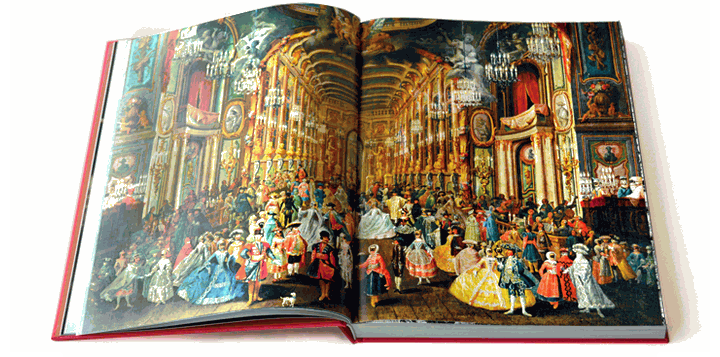
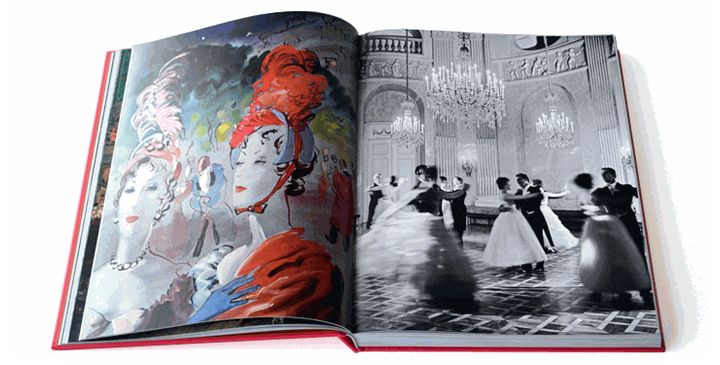
"From the twilight of the Romanov dynasty through the les annees folles of Art Deco Paris to the jet-set seventies, Bals explores the nine most exceptional private costume parties of the twentieth century."
-from the Assouline website


Though this title wouldn't have been my first choice (that's 'balls' in French, not a typo), I definitely want this book. I absolutely covet large picture-reference books. They are my favorite source of inspiration. There's something about turning the pages and feeling the weight of the book in your lap that makes the pictures seem even more special - not to mention the fact that resolution is almost never a problem! Here's a sneak peek of what to expect inside:


"Since the guests were asked to arrive in gondolas rather than in motor launches, the scenes outside as well as inside the palace... gave the impression of a Canaletto come to life." -Cecil Beaton, describing the scene at Don Carlos de Beistegui's 1951 ball in Venice's Palazzo Labia.


Basically, it looks like it will be a huge drool-fest for anyone who loves historical costumes as much as I do and would be a brilliant addition to any real-life library. Normally I would put a link to this product on the Amazon website since I've decided to whore myself out to them just a little (thus my lack of a tirade on the death of Borders), but this is actually a product that Amazon doesn't carry! So, instead click here to visit the Assouline website and purchase this beautiful book.

Farewell on this First Folio Friday,

Enhanced by Zemanta

Friday, November 26, 2010

Hindsight - On How to Be Lovely

So, yes, I haven't posted in a while. This week has been pretty crazy - guests, kittens, etc. I'm now completely unsure as to where I will be living starting in February. I may return to San Francisco to continue on-campus studies, or I may remain here in New Orleans until the summer... Everything is up in the air. I've also got finals coming up, followed by Christmas and New Year's. I can't promise to post every day, but I will do my best to post at least twice (if not thrice) a week. Did you like my little inclusion of thrice there? It's one of my favorite obscure words.

A mother plays the guitar while her two daught...Image via Wikipedia
Zemanta Assistant seemed to think this picture was relevant to my article...?

Anyway, today I wanted to share some vintage beauty tips. I find these videos bizarrely fascinating. I guess I'm really just a historical voyeur in that I love catching glimpses of daily life in other time periods. I got the title for this from one of my favorite movies, "Funny Face":


On to the point. I've recently discovered the delights of Glamour Daze - in their own words "An Archive of Vintage Fashion and Beauty". If you haven't had a chance to peruse this blog to head over there and poke around. It's definitely worth it! They also do a series of Youtube uploads of vintage beauty and glamor one-reels. I've posted a few of my favorites below. Enjoy!

Movie Starlet Constance Bennet's Guide to Skin Care - late 30s. I always sleep with my makeup on, don't you?


A "Guide to Glamour" from 1940s stylist Ratherly Stern. I honestly think that teaching young people (not just girls) about good posture and hygiene is important.


And here a beauty series from the 1950s:


Remember, girls: Soda pop and a big gooey sundae do not a balanced diet make!
Nostalgically Yours

Enhanced by Zemanta

Thursday, October 21, 2010

Mohair Dream for 1927

Just a little doodle I came up with in one of my random surges of creativity. It has weird shadows on the bottom because my scanner is acting up, so I had to hold up the paper in front of me and upload a photo from my iPhone directly to Facebook because I inexplicably can't save pictures on my phone anymore... Isn't technology just a dream? Here it is:


Anyway, as is my custom, I enjoy designing for different time periods. This is a mohair and fox fur coat designed for about 1927. If I were to make it today I would use faux fur, don't fret! It might seem a tad short but I presume the lady would have worn her dress just an inch or so longer than the coat. The hat is of wool felt dyed to match the mohair with a suede hat band to match the gloves and shoes. Hope you like it!

Saturday, September 25, 2010

Hindsight - Not Your Momma's Platform Heels!

“Fashion is a form of ugliness so intolerable that we have to alter it every six months.” -Oscar Wilde


Today I introduce yet another segment. As you may have deduced from the quote featured above, I will use "Hindsight" to discuss the amazing and peculiar trends of days gone by which, in retrospect, might seem a bit silly.

As I'm sure many of you know, Lady Gaga has had mixed reviews about her wardrobe for this year's MTV Video Music Awards, including a dress made of raw meat (not pictured) and a pair of Alexander McQueen's signature "Armadillo" shoes:


I've heard many complaints about these heels - though I quite honestly think she deserves praise for putting on these babies - but let's take a trip back in time and explore the history of the chopine.


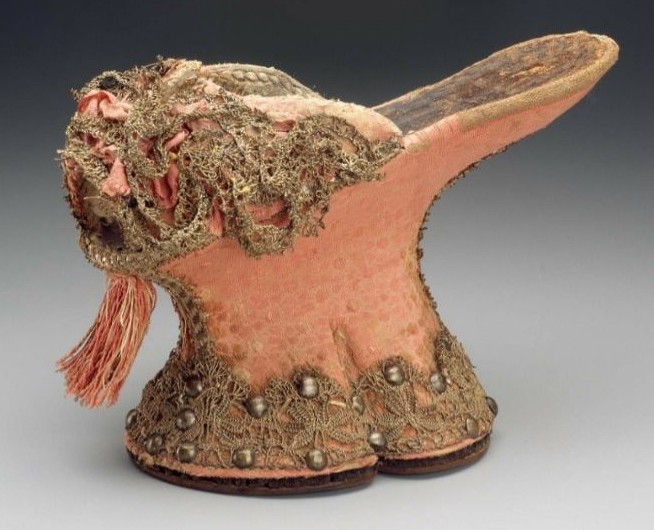
Chopines (or Zoccoli, as they were called in olden days) were platformed over-shoes that became popular towards the end of the Dark Ages in Renaissance Europe. Originally intended to keep the hem of a lady's dress from dragging in the mud, the chopine (and the added height given by it) became a status symbol. They were most popular in Spain and parts of Italy - Venice and Florence, specifically - and hit their highest in the 17th century.

For all intents and purposes, you might be wondering exactly why these are a trend we would look back upon and ridicule, especially when compared to McQueen's "Armadillos". Here is why:


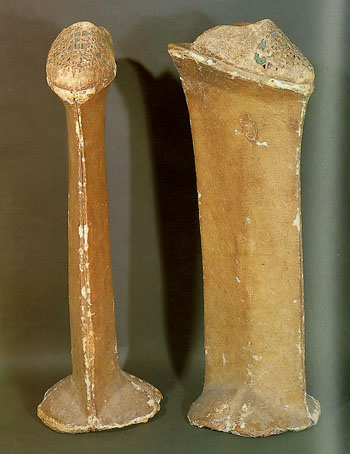
These zoccoli are around 20 inches tall! To say that these over-(the top)-shoes were impractical would be a gross understatement. In fact, the women who wore these gargantuan things needed attendants to walk with them in order to keep their balance. The fashion was often ridiculed in literature of the time, as evidenced by this "smutty" caricature:


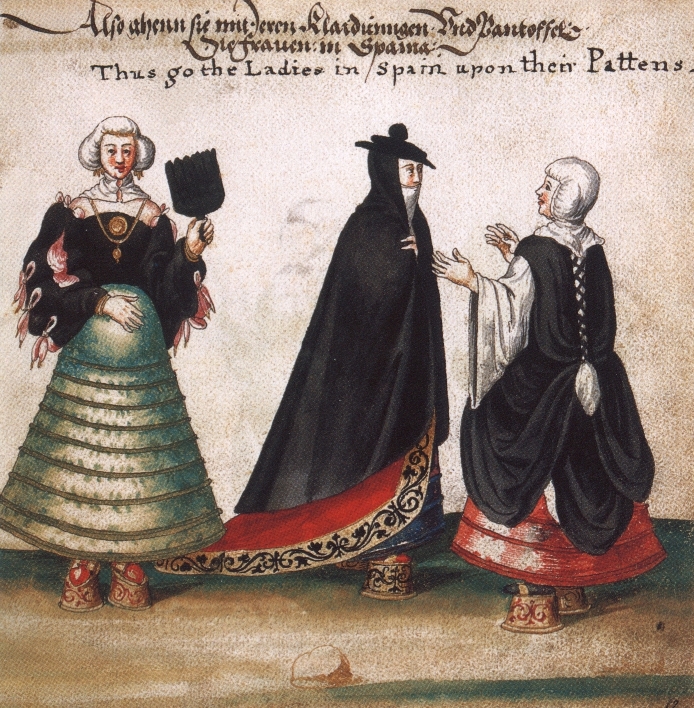
Contrary to what this drawing presents, there is some conjecture as to whether or not a lady's skirts would have covered the chopines... Here's an example of women who showed off their zoccoli:


Notice how these Spanish women all leave their chopines clearly visible beneath their ringed "verdugado" skirts (to clarify, these women are fully clothed - these earliest known ancestors to the hoop skirt and cage crinoline featured the wooden hoops in the outermost skirt). Clearly different women chose to wear them in different ways. I think the most  obvious way to tell if a certain zoccoli was covered or not is to look at how ornate the decoration is. Of the following two examples, the first would probably have been covered by the skirt whereas the second, more delicate example may have been worn to a ball or party and might have been proudly displayed - after all, they were a status symbol.


Of course, the fact that it was a status symbol is also a matter of debate amongst experts. Some say that only Venetian courtesans wore these high over-shoes to make themselves more visible to clients. Others say that zoccoli were reserved for the most prominent female Venetians. Much like Francis Classe, I believe that both women would have worn these shoes, considering the lavish gifts Venetian men would have had to lay upon their courtesans to keep their interest, and then on their wives to keep them quiet. It's not too difficult to imagine a great social battle between the Ladies and Mistresses of Venice... Female competition is the only logical explanation I can think of that might lead to 20-inch chopines.


Hope this was insightful and entertaining - and hey, maybe next time you complain about the four-inch heels you wore to go clubbing you'll remember what these women endured for fashion!

Hoping sincerely that none of your are ever subjected to such tremendous heels,
Nostalgically Yours


Thanks to the following sources for information and pictures:
Francis Classe
Museum of Fine Arts Boston
Metropolitan Museum of Art New York
Enhanced by Zemanta

Friday, August 27, 2010

Regency Portrait

As promised in my Preview Post, this portrait was a project I've been working on for a while. You can see a thumbnail sketch in the preview post. As you already know I love anything old-fashioned, and I especially love the portraits of days gone by. Unlike modern photography, the portraits of yore were really big deals, and were reserved only for the wealthier classes. Portraits were considered a status symbol, and were hung in important places in the stately homes of the past.

Beau Brummell:
THE premiere Regency Gentleman


Anyway, to make a long story short, I decided to draw myself as a Regency Gentleman. If this makes sense to you, then by all means skip to the picture.

For those readers that don't know, the Regency Period is a broad term used to describe the fashion, architecture, literature, and culture of the years between the French Revolution in 1789 and the ascent of Queen Victoria to the British throne in 1837. Personally, I cut off the Regency period at 1820, and call the period between 1820-1837 the Romantic period, but that's getting a bit too specific. The Regency Period is most recognized and remembered through the works of Jane Austen. She wrote most of her works around 1800, and her novels (including Pride & Prejudice, Sense & Sensibility, and Emma) have become indelibly linked with this period.

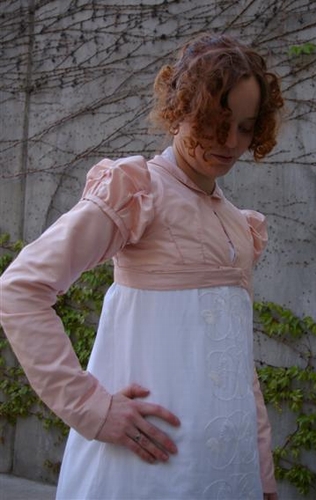
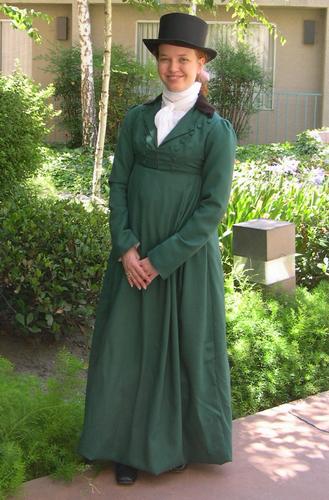
The Regency Period for women was defined by a high waistline, light flowing fabrics, and a generally militaristic and masculine silhouette in outerwear. The corset was less rigid than those of the prior centuries, and was intended only to soften the woman's curves, highly visible under clingy gowns. The bust was also lifted and separated by a wide busk in the front of the corset.

A Spencer Jacket
Ladies' Riding Habit


Two corsets of the time, one with busk
Menswear saw the creation of the modern suit. The collar was high and stiff, and was worn with intricate cravats the ranging complexity of which marked a gentleman's social standing. After the French Revolution, looking rich was not only a fashion faux-pas but could be dangerous. This made wearing jackets, pants, and vests of different colors quite popular. Also, thanks to the influence of philosophers such as Rousseau, the country became the place to be and equestrian styles dominated. This was also the time of Beau Brummel (expect a post on him).

The only Darcy that will ever have my heart...
Do we really need another menswear picture?
Since I love this period so much, I chose to use this as the setting for my first self-portrait. I've always thought I'd look dashing in a high collar and cravat - don't you agree?

How do I look?
Hope you liked it, and expect my review of Project Runway later today!
Nostalgically Yours


Some more interesting links on Regency Fashion:
Regency Era Primer
Distinctions in Regency Dress: Full, Half, and Undress
Spencers, Pelisses, and Cloaks: Women's Regency Outerwear

Photo Credits:
Beau Brummell: Jane Austen's World
Women's Costumes: The Fashionable Past - Katherine's Costume Site
Busk Corset: Egg-box Marketing
Colin Firth as Darcy: 51 Degrees North
Enhanced by Zemanta

Wednesday, July 28, 2010

Summer Project #1 - Medieval Dress - Part III

Well, it's been a while since I wrote about this, so if you need a refresher or you haven't read the first two parts, please see Part I and Part II.

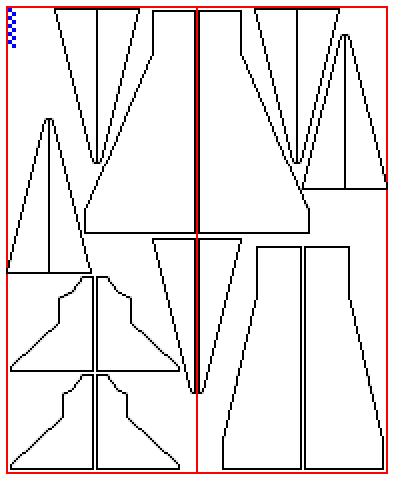
So the cutting was going to be a challenge. I had a very limited amount of fabric and a set number of pattern pieces that I absolutely needed to cut. Since I wanted to waste as little fabric as possible, I decided to create a marker. If you don't know what that is, and/or you wanted a detailed explanation of how I went about making my own makers, you can read that post here. Here's what I ended up with:

Creating my own marker helped me see that I had enough room for five godets!

So I cut out all the pieces and started sewing them together. I first attached the godets to the dress panels, aligning the bottoms (which would later turn out to be a mistake). After the godet was inserted into the open seam, I pinned up from the point of the godet up the rest of the seam, like so:

1) Lay out the godet within the seam, not forgetting to true your pieces so the ends all match up nicely.
2) Pin and sew the godet to one side of your seam, right sides together
3) Now do the same with the opposite side.
4) Finally, close the rest of the seam - if you're ambitious you can combine steps 3 and 4.

Of course, I managed to forget to true the seams, so I ended up with this:


Neither of my seams matched up...


So after I re-finishing all the seams and godets, I cut the sleeves and inserted them. I decided the gown needed something more, though, so I went out to my local fabric store to pick an elegant lining for the sleeves. I was very lucky to find the perfect fabric on sale for $5/yard. It had an elegant border which I decided to use to my advantage.


By placing the sleeve pattern right against the decorative border, once I set the sleeve in, I would be able to wrap the border around to the exterior side. I also used some of the border along the open top seam of the sleeves and around the collar. Here is the end result:

The wrapping of the sleeve border is clearer in this picture.

This detail of the sleeve shows what the border looks like on the outside of the sleeve.

Once that was done I had my cousin come over for a fitting. Unfortunately the chemise was too tight around the bust, and she couldn't easily lift her arms - which was a problem considering she needed to dance in this costume. So, back to the drawing board... After careful consideration I decided not to re-cut the bodice. Instead, I chose to rely on a good old Medieval friend again: the gusset.
As I will explain in my main article tomorrow, gussets can be used in a variety of ways to expand seams where extra movement or give is necessary. These are not to be confused with the godets mentioned above (more here).

Side view of chemise with arm raised, before expansion...
...and after the expansion.

Before I added the gusset, the area pulled and tugged around her bust and bicep. After adding the gusset, it fit quite well. I think it's clear from my illustration exactly why it is called a kite gusset.

Once I finished fitting the chemise the second time, I had only to finish the neck. I decided to use bias for that. I made two eyelets near the center of the front bias, then wrapped this around the front of the chemise, where I had already attached the two pieces of cording.

I think the whole thing turned out pretty well, and I heard the dress received nothing but compliments at her Medieval Fair. She was the only one there with a home-made costume.

Stay tuned for the final installment in this exciting series: Pictures!


Nostalgically Yours
Enhanced by Zemanta

Monday, July 5, 2010

Summer Project #1 - Medieval Dress - Part II

If you haven't read the first part of this project, you can do so here.


So, now it was on with the pattern! Thanks to the book I won with my Senior Thesis collection at my High School vocational program, Patternmaking for Fashion Design by Helen Joseph-Armstrong, I have a valuable resource on modern pattern making for all of my sewing projects. However, I really wanted to do some research on authentic patterns of the Medieval period in order to get the fit of a real medieval gown. The internet gave me lots of great information, including some stuff I already knew like the popularity of godets. In retrospect I would have liked to have drafted the whole pattern from some similarly-shaped gowns I found online, but after measuring my cousin I noticed she would fit right into a shortened version of the size 6 block I had made in my Sewing Class at AAU last semester.


Can we just let that sink in for a second? My 11-year-old cousin fits into an industry standard size 6. What exactly does that say about our standards of beauty? Moving on...


Since I was using my block, I reverted to HJA's book for a silhouette that mimicked the Medieval look. I definitely wanted no darts in the dress, but she needed enough space to dance in it, too. Conveniently enough, there is an entire section in the book dedicated to "Dresses without Waistline Seams", all based on the torso foundation. First I started on the chemise. I decided on a box fit dress: A non-fitted shift without any fish-eye darts. The problem here was what to do with the bust dart, which is still required for the dress to actually contour the bust. Here's where I got clever. Having read that drawstrings were a very common closure in Medieval tailoring, I decided to transfer the bust dart upwards, create added fullness, and have a drawstring across the center front. Brilliant, I know. Here are some illustrations to show my work:


Here I show where I transferred the dart.


Here I've transferred the bust dart upwards, closing the one on the side. I've also eliminated the back shoulder dart, ensuring the shoulder seam is trued. Finally, as per the directions in the book, I added a half inch to the waistlines, blending to zero on the hip and side seams.


Here I re-drafted the necklines. The front is curved to allow for the bust fullness - once drawn in with string it will lie straight.


For the gown I knew I wanted a lot of fullness, and the fitting wasn't important anywhere but the arms and shoulder, so I went with a tent dress. This is the same basic principle as a flared skirt, except instead of converting just the skirt darts to flare at the hem, one converts all of the darts on the torso foundation to flare by slashing like so:


First I cut along these slash-lines...


...and opened the darts downward, widening the body and the hem...


...and finally I redrafted the neckline to match the chemise.


Don't forget the sleeves! For the chemise I simply redrew the block without the elbow dart. Above you can see what I did for the gown: I redrafted the outer lines to make the long opening at the wrist that was so fashionable back then. Also, I slashed the sleeve down the middle to create an opening along the top of the arm. Here I intended to put in more lacing so the sleeve could be worn open or closed!


As I mentioned, I had done much research in terms of Medieval construction. So none of the gown's pattern pieces were on the fold. "Why?" you might ask. Simple: four seams instead of two allows more room for godets. Also, the closure was intended to be lacing up the front of the gown, so that required an open seam.


Now that I had my patterns designed, my next step was to cut everything out. Some of you might be noticing by now that I have omitted the pattern for the sideless surcote. As it happens I was running very short of time at this point, so I decided instead to make a somewhat more elaborate gown.


More later.
Nostalgically Yours

Read Part III