Showing posts with label fashion. Show all posts

Friday, July 27, 2012

Festival Friday - Wedding of the Painted Doll

Yesterday I faced one of my biggest phobias at the 63rd Annual United Federation of Doll Clubs National Convention. I decided to push through the fear for two reasons. One, I'm considering starting up a line of paper dolls, and Two, vintage fashions!

Similar to Comic Con and other conventions, the event featured vendors from all over the country and around the world, selling dolls and all sorts of accessories and other paraphernalia. I had a marvelous time (despite my discomfort) and met some positively lovely people. The following photographs will do a much better job at describing the event than I could. If you're interested in any of the merchandise or vendors you see, click the images for contact information or websites.


The first booth we visited featured a variety of antique dolls, varying widely in origin, style, and period.


This stall featured delightful doll-oriented miniatures:


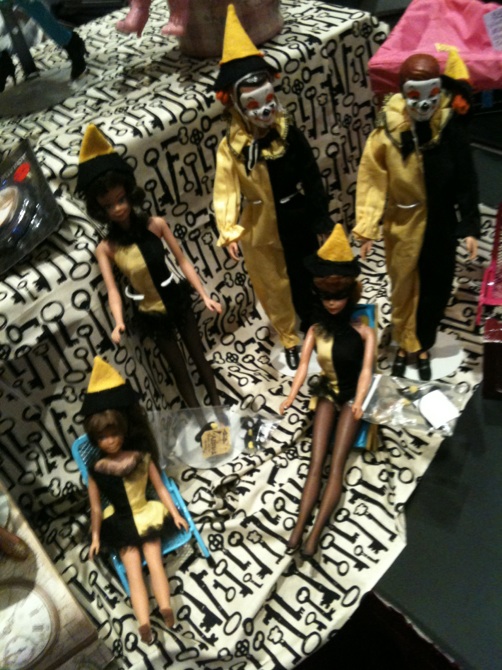
Here's a set of vintage Barbie Collection Dolls dressed for Mardi Gras!

Here's a delightful spice cabinet featuring all sorts of miniatures perfect for any doll's house.


Yes, that is an original first-run Barbie Doll on the far left. Unfortunately, I seem to have misplaced this vendor's information. If any UFDC members recognize this stall, please let me know so I can properly credit the merchandise.


One booth featured a series of doll houses, including this French schoolhouse with an automaton teacher! Note the intricate detailing of the schoolbooks.


I actually considered buying these Art Deco cloth dolls. They are absolutely adorable!


A pair of Emma Clears. Very popular at the convention.


This is a very rare and unusual reclining doll. I meant to take a close-up picture of her body under her skirt, since she looks a bit odd without her dress on. The lounge chair is assumed to be from the 1920s or 30s.

I do love doll houses and miniatures, so this booth was right up my alley, featuring mini books (some fully printed), glass and table ware, and jewelry.


This booth was probably my favorite. After the vendor's mother passed, she and her family found these collections in her house. Along with a large variety of children's and doll's shoes, they also discovered an enormous collection of rare paper dolls. The one featured below is able to open and close its eyes thanks to an ingenious flap. The second paper doll is a reversible doll c. 1913.


Something I learned at the convention: A lot of antique dolls had removable wigs to be able to change their hair styles.


This doll has a story and an entire trousseau to go with it! This picture didn't come out that well, but you can see better photos on their website.


The last booth I visited had two of the most striking dolls I saw that day. This vendor asked to be credited as Jackie Allington of the Bahamas but didn't give any contact information. The doll on the left is an automaton and you can see her in motion below.


Sorry about the video quality on this. It's taken me close to an hour to get it uploading and I just don't have the patience to keep dealing with Google products today.

So I ultimately had a good time and was able to get past my anxieties. There is one doll that I omitted from this post for the simple reason that the photo I thought I took of her vanished from my phone. You can see The Merry Widow Allegra here. She's a rather funny, very unusual doll, so do check her out! If you're curious about the UFDC, you can visit their website here. Have a great weekend, readers!


Monday, July 16, 2012

Food For Thought - Funeral Dress

WARNING: This post contains images of bones, mummies, and other death-related things that some readers may find disturbing. If you'd like to read this post without pictures, please click here.

Everyone dies, and we've all probably thought a bit about what we want our loved ones to do with our remains. However, of all the arrangements we think about, furthest from my mind would be the clothes I'd be buried in. Even further from my mind would be the idea of being disinterred for the purposes of historical studies.

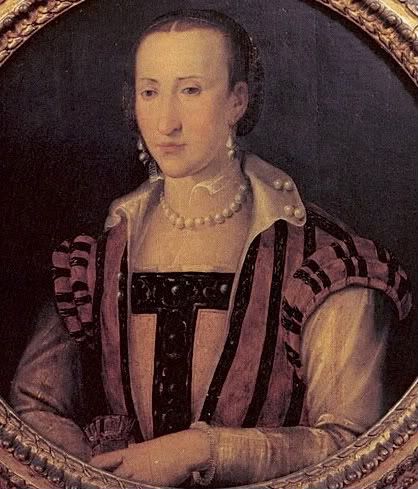
Of course, most of us are probably nowhere near as famous as, say, Eleanor of Toledo, who married Cosimo I de' Medici in 1539, effectively paving the way for the Medici's reign and is credited with being the first modern First Lady. She died in 1562 and was buried in this dress:


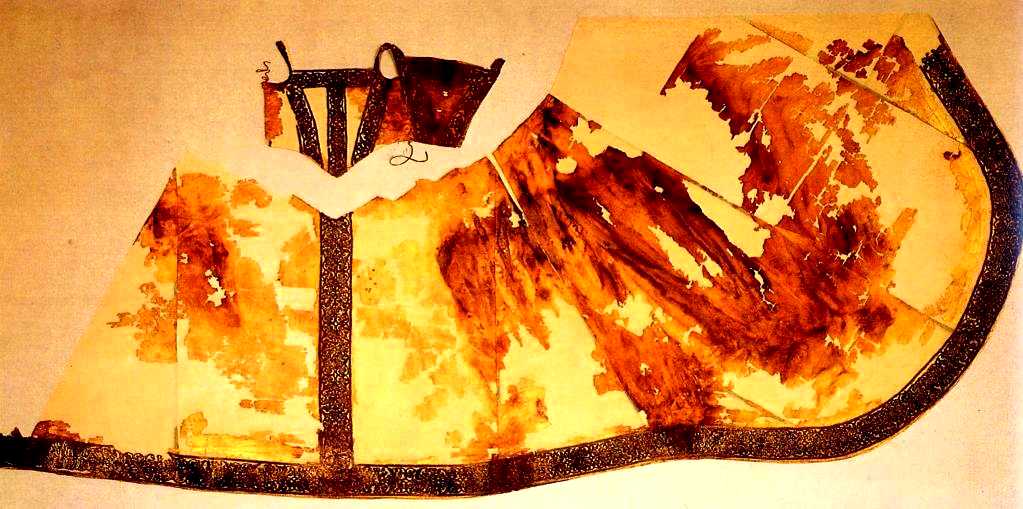
When the Medici tomb was opened in 1857, this was one of the artifacts recovered. You can read more about it and other 16th century funeral dresses here.

The extant dress, complete with lovely liquefied flesh stains.
Of course, we have always turned to burial sites and tombs as insights into cultures past. In some cases, these sites remain some of the last undisturbed sources of historical artifacts. However, when disturbing the rest of the dead, what (if any) rules should be followed? Is there a time limit before it becomes creepy? Is it ever okay to dig up the dead for the sake of posterity?

"This is totally for posterity. We swear."
I suppose that in the presence of plunderers and grave robbers it's better for archaeologists to do it methodically and respectfully. If it will be done by hoodlums better to have the items preserved in a museum and used to learn new things about cultures past. I guess if you decided to be buried with all kinds of crazy riches, that sort of thing is to be expected. There's bound to be at least person who adopts the "You Can't Take it With You" way of thinking. In countries like Peru, the sacking of tombs for pottery, jewelry and other artifacts is pretty much commonplace. This industry is sustained by a black market of private collectors and tourists who, despite countless warnings against the destruction of cultural heritage, still buy the stolen goods for the sake of owning a piece of history.

peru 086
The results of grave robbery in Peru
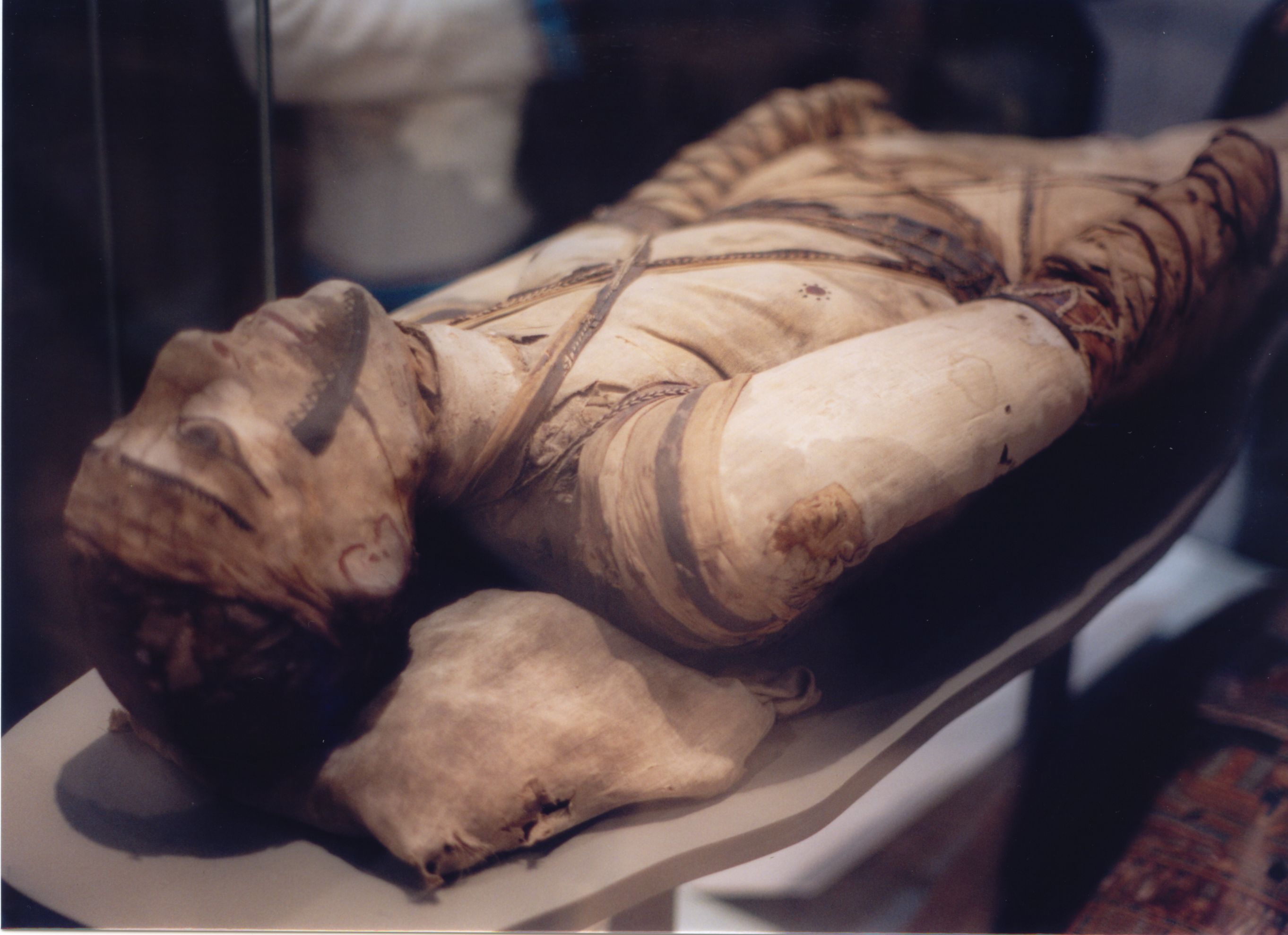
That brings up another point; museums. Is it wrong to display the personal belongings (and even the bodies) of ancient and not-so-ancient peoples? At what point does it cross over from interesting to macabre to show corpses in glass cases? The mummies of Egyptian pharaohs don't seem to bother us too much, but what about the bodies of regular people, mummified naturally and were disinterred between 1865 and 1958 if and when family members were unable to pay the please don't dig up my dead relatives tax. Apparently the bodies were dumped in a warehouse, and the mummified bodies attracted enough attention to eventually warrant the construction of a museum for the corpses. No, seriously.

"Don't mind me, just acting out my last minutes of horror at being buried alive
for the price of admission."
How is this different from viewing the remains of a king? Does him being an important personage make it okay? I've always found museums to be spooky for this very reason: to see a person's entire life on display. Especially when so many different lives (and cultures) are crammed into one building. It must be at the very least bad karma.

"Nah, we're cool."
We don't really think about are adverse conditions in which our own bodies might be freakishly preserved and then put on display like the above-mentioned Mummies of Guanajuanto, so I assume we also wouldn't think about a situation where our entire city might become a walk-through horror show/monument. That's exactly what happened to the people of Pompeii and Herculaneum in 79CE when Mount Vesuvius Erupted and buried large expanses of both cities with unbelievably hot pumice and ash. Those who were unlucky enough to be in the path of this terrifying torrent had their lungs with hot ash with had the charming effect of both burning their lungs like rice paper and suffocating them at the same time. The pyroclastic flow was so fast that most people didn't even have time to react to what was happening to them, and their last moment was preserved long after their bodies had smoldered away, since the very pumice that killed them decided that the awful way in which it killed them wasn't awful enough and decided that preserving their grotesque final expressions was the perfect salt to rub into wound created when their brains exploded from the intense and sudden heat.

Asshole.
When Pompeii and Herculaneum were excavated, one of the archaeologists discovered that by encasing the skeletons they found in concrete, they could fill in the negative space left by the skin and organs to re-create and preserve these people's most terrifying moment.

"Thank God I can stay this way for all eternity."
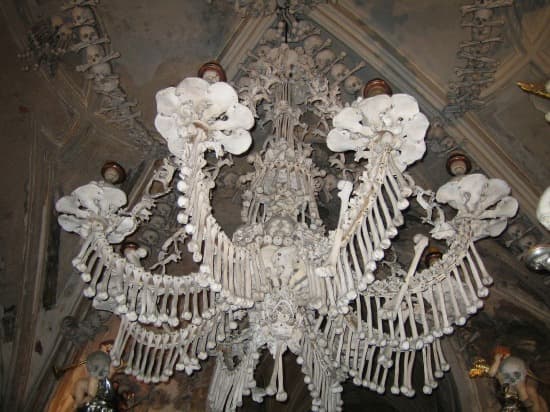
Then we have places like the Sedlec Ossuary in Prague where the remains of between 40,000-70,000 people who died during the Black Plague and Hussite Wars. Oh, but it gets better. When they remodeled the church in the 19th Century, they looked around the Ossuary and thought, "Gee, these bones are a bit of a downer. Hey you, František Rint, can you do something about these bones?"

"That's much better"
Yeah. They basically turned it into the death-obsessed Victorians' wet dream. I don't get it either, but the necessity for burial space during outbreaks of Plagues and other Epidemics seems to be the perfect fodder for horror fests such as these. I remember being coerced into visiting countless catacombs when I lived in Peru.

"I DON'T CARE IF IT'S EMOTIONALLY SCARRING.
I ALREADY BOUGHT YOUR TICKET" (more or less)
Of course, nowadays our history books seems to glaze over a lot of the bits about death and dying and how a good chunk of our historical record of Past Civilizations comes from their tombs. Though I like it a lot more than the outlook we had just over a hundred years ago.

Because we want to remember our daughter as she was,
a lifeless, cold, dead-eyed corpse.
I'm not trying to prove a specific point here, mind you. I'm not trying to say that all museums should be torn down or that studying ancient cultures is wrong. I'm mostly musing. In fact, I'd really like to hear your opinions on the subject. What do you think?

Friday, June 15, 2012

Fashion Friday - Give Three-Piece a Chance

Last month a protest was held on the famous Saville Row. Several hundred people took to the street to protest the encroaching of Abercrombie & Fitch upon one of the most Venerable Institutions of the Fashion Industry. Unfortunately, this protest - or the cause of it, rather - heralds the final chapter of the Age of Couture.


This all started at the end of the 19th century, with a man named Charles Dana Gibson. Gibson was a turn of the century illustrator, and while he didn't invent the styles of the 1890s and 1900s, he is widely credited with popularizing the look we now know as the "Gibson Girl". This might not have been revolutionary. It might have been simply the latest in the series of fashionable changes to Victorian dress, except for one thing: for the first time in history it became fashionable for women to wear separates.


Before then, stylish ladies had worn dresses almost exclusively. This had left dressmaking in the exclusive realm of individual tailors and seamstresses, as the corseted and bustled figures made standardized sizing and mass-manufacturing impossible. The only people who bought pre-made clothing were sailors and other workmen who didn't have any family to make them clothes. This was looked down upon by the upper classes. While Sears-Roebuck and others also produced clothing for their catalogues, these, too, were considered déclassé.

With the arrival of these fashionable separate skirts and blouses (then known as shirtwaists), standardized measurements and mass production became not only a possibility but a reality. Manufacturers began popping up all over major cities - you may have heard of the Triangle Shirtwaist Factory Fire.


Ready-to-wear slowly pushed it's way to the forefront of culture and society, and got special boosts with each of the world wars. However, couture was still king in the fashionable circles. Wealthy women still traveled to Paris each season to purchase new gowns, dresses, suits, etc.

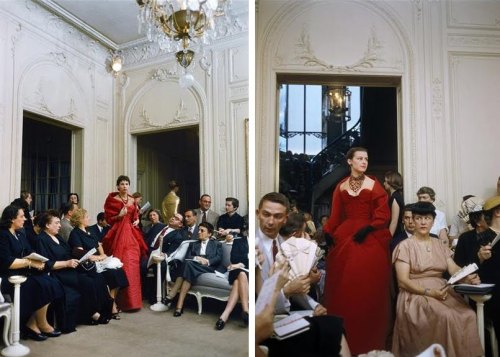
A Dior Haute Couture Show, 1950s
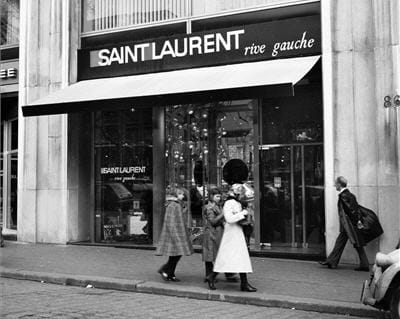
The next part of the story begins on October 23rd, 1957. Christian Dior, the toast of Paris, dies of a heart attack while on vacation in Montecatini, Italy. In his wake, Yves Saint-Laurent is tapped to take over the fashion juggernaut that is Dior. However, after only a few years, the investors butt heads with the young designer purposefully fail to have him excused from his military conscription. After several years of struggles with military service, doctors, and drugs, Saint-Laurent pulled himself together and in 1966 announced a ready-to-wear line. While other designers also had prêt-à-porter lines in the works, YSL is greatly credited with being the first due to his strong ideas on the subject of democratizing fashion. Saint-Laurent's Rive Gauche stores were a huge success, and this spelled the beginning of the end for couture.


It's interesting to note that it was around this time that the miniskirt came into fashion. This is widely considered to have been the last major fashion trend. Nothing since has been so widely pervasive as the miniskirt, and it heralded the end of institutionalized fashion, where Parisian couturiers dictated the styles to the masses.


Nowadays, design companies lose money on their couture lines, and they are becoming less and less prevalent as the shows become too expensive to produce and as more and more of the artisans and craftspeople who provided lace, feathers, beading, and all of that to the design houses fold due to economic hardship. In spite of this, Saville Row has remained a bastion of bespoke against the rising tide of ready-to-wear. The tailors and seamstresses of Saville Row resent that a fast fashion company such as Abercrombie & Fitch would trespass onto what is effectively the Vatican of tailoring, and consider it both disrespectful and an economic threat.


However, will their cries be ignored? Will the suit-makers of Saville Row be swallowed up by fast fashion the way Barnes & Noble or Starbucks swallowed up so many businesses before them? Will centuries of experience and incomparable quality be replaced by lower prices and quick turn-around times? I believe they will, sadly. They simply cannot compete in a society that holds price above all other aspects of a product. I hope they'll stick around for a while yet, and at the very least live to preserve their wisdom for posterity.

Tuesday, May 8, 2012

Food For Thought - Beyoncé's "Countdown"

It seems that Mrs. Beyoncé Knowles-Z has decided that her entire career is going to be dedicated to providing fodder for my blog posts. I don't have a problem with that, I'm just sayin'... This time it's her new video for Countdown:


For me, the most obvious inspiration is right here:


Yes, everyone remembers that famous Gap commercial that features Audrey Hepburn dancing (but not wearing Gap clothing). Fewer people remember where that footage of Ms. Hepburn came from:


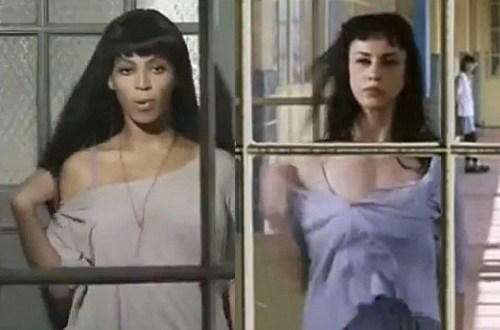
That dance comes from Funny Face, one of my all-time favorite movies, and clearly also one of Beyonce's, as she's drawn inspiration from it before. The outfits of the musicians match those of Hepburn's backup dancers, and even the layout of the bandstand shots mimics that of the nightclub set from the movie. The dancing, however, doesn't match. It clearly took me too long to write this article because just in the week or so since I began researching this article, there has been an explosion of press regarding similarities between "Countdown" and the choreography of Anne Teresa De Keersmaeker. To see a side-by-side comparison of De Keersmaeker and the music video, click here.

"Achterland", left, "Countdown", right.
Left and right, Beyoncé is being accused of stealing the choreography from De Keersmaeker. So much so that Knowles decided to release an alternate version of the video that excluded all of the controversial footage. Even De Keersmaeker herself had some things to say  about the music video, though she seems kinder than most. This is similar to the criticism rained down on Lady Gaga every time she does anything that even remotely resembles anything Madonna has done. Because Madonna has never, ever imitated anyone herself, right?

Right?
If you're like me, you were incessantly lectured about plagiarism in school (if you're really like me, you worries about being accused of plagiarizing even after taking every precaution to avoid it). What were the things we were told to do to ensure we weren't plagiarizing someone else's work?
  • Re-write the information in your own words.
  • Use multiple sources.
  • Credit the author(s) of the work.
Knowles has done all but one of those things- she took the parts of the dances she liked and changed the context; she set it to different music and put different bits of the choreography together. De Keersmaeker has pointed out that even though they are performing the same dance, what Knowles and her dancers are doing is distinct from the films they mimic because of their context:

"In the 1980s, this was seen as a statement of girl power, based on assuming a feminine stance on sexual expression. I was often asked then if it was feminist. Now that I see Beyoncé dancing it, I find it pleasant but I don’t see any edge to it. It’s seductive in an entertaining consumerist way."

"Countdown", left. "Rosas danst Rosas", right.
Knowles also took inspiration from all kinds of other sources: Op art, Pop art, Mary Quant, Whtiney Houston... even Gap commercials! All of these things together created a unique work that is separate from all of its inspirations yet tied to them at the same time.


Now, I do believe Knowles and her team should have credited De Keersmaeker since they did borrow so heavily (and directly) from her, especially since they credited Boyz II Men after sampling from their song "Uhh, Ahh". However, according to a GQ interview with the video's director, Andria Petty, it was the team's intention to credit her but they overlooked this due to the tight deadline.

Can you say Andy Warhol?
This isn't the first time Knowles has borrowed heavily from others, nor will it be the last. This is also not the first time this sort of happened in the music video industry, nor in the music industry at large. Paula Abdul's "Rush Rush" is basically "Rebel Without a Cause", and Madonna's "Express Yourself" is basically "Metropolis". Music sampling has existed for decades. "Ice Ice Baby" sampled from "Under Pressure", "Rapper's Delight" sampled from "Good Times", "U Can't Touch This" sampled from "Super Freak"... The list goes on and on... If artists can't borrow from each other or imitate or build upon the work of others, then art cannot advance.

Knowles in Thierry Mugler
In addition, Beyoncé used the choreography to a different end than De Keersmaeker. The original footage was a work of choreography. It was a dance film. Knowles was presenting a video for her song. She was not presenting a dance, she was presenting a music video.


Finally, I think this whole climate of ideas as property contributes to rise of dangerous legislation such as CISPA. If we continue to consider artistic ideas as property in every context then we will be left with major corporations holding a monopoly on creativity because they're the only ones with the money to consistently defend "their" properties. We need to chill out about these kinds of things and start worrying about bigger problems.

Hope I haven't completely chewed off your ears!