In my previous post on "
Coffee Time", a musical number from the 1945 MGM musical "
Yolanda and the Thief", I erroneously stated that
Lucille Bremer was
Fred Astaire's mistress.
My father, a big film history buff sent me this message to correct me:
"Hi Kiddo -- I have been enjoying "Nostalgically Yours"--it's a very impressive blog. But I must rush to correct a fact in your blurb on "Yolanda and the Thief." Fred and Lucille Bremer were NOT romantically involved offscreen as you report. Fred was from all accounts faithful and devoted to his first wife, Phyllis Potter, whom he married in 1933, and with whom he had three children. Mrs. Astaire died of cancer in 1954; Astaire did not remarry until 1981. Lucille Bremer (1916-1996), a former Rockette, WAS rumored to be involved, not with Astaire, but rather with the great MGM producer Arthur Freed, who built her up in pictures like "Yolanda," "Ziegfeld Follies," "Meet Me in St. Louis," and "Till the Clouds Roll By" (the Jerome Kern biopic). Despite dancing talent, Bremer (in the words of her frequent director Vincente Minnelli) "lacked the ambition to be a star," and after several more minor movie roles quit Hollywood to marry the son of the provisional president of Mexico ("She became Yolanda," as my professor and friend, the late Joel E. Siegel, once put it). In later life, after divorce, she owned a dress boutique in Southern California. David Thomson, who deeply admired the "vivid, useless excellence" of Astaire's art, perhaps summed up why Astaire worked so well with Bremer, "another rather heartless dancer." Not so vivid but still useless information from Ol' Dad."
As I read a light bulb went off. My dad is a practically endless source of interesting stories - stories that go really well with my blog... Why not let him strut his stuff and exercise his writing chops? Well, I'm proud to introduce my new segment: Good Ol', Dear Ol' Dad. For his first column, he decided to write a follow-up obit to my previous blurb on the passing of
Jane Russell: "
A Farewell to Cleavage". Introducing 'Good Ol', Dear Ol' Dad':
FAREWELL TO A FULL-FIGURED GIRL
Sex Symbol with a Sense of Humor
We note with sadness the passing of Jane Russell this week at age 89. In tributes to Jane, much was made of how her voluptuousness was exploited and marketed by Howard Hughes, who discovered her and put her under personal contract for many years, as well as her good works as the founder of an organization to facilitate the placement of adoptive children. Some, but not nearly enough, attention was paid to the rare role she played in movies of the 1940s and 1950s: sex goddess with a sense of humor. As such, she brightened several movies that are still worth catching, in whole or in part.
Gentlemen Prefer Blondes (1953):
Jane's best known and best loved "mainstream" movie was done on loan to 20th Century-Fox, where she holds her own opposite that studio's new star,
Marilyn Monroe. The film is sort of a passing of the torch from an established sex symbol to an upstart, but the two female stars create a generous and respectful mutual synergy--Jane even does a funny but still gracious Monroe impersonation in a courtroom scene. Tommy Noonan, Elliott Reed, and the great character actor Charles Coburn are the mainly non-threatening males who pursue Jane and Marilyn on an ocean liner. (Ten year old George Winslow, with his deadpan expression and prematurely deep voice, is the only vaguely "adult" male on board.) This very amusing film probably remains so satisfying because of the way director Howard Hawks adroitly get stars performances from Jane and Marilyn in the context of the superb ensemble playing of the eccentric supporting cast.
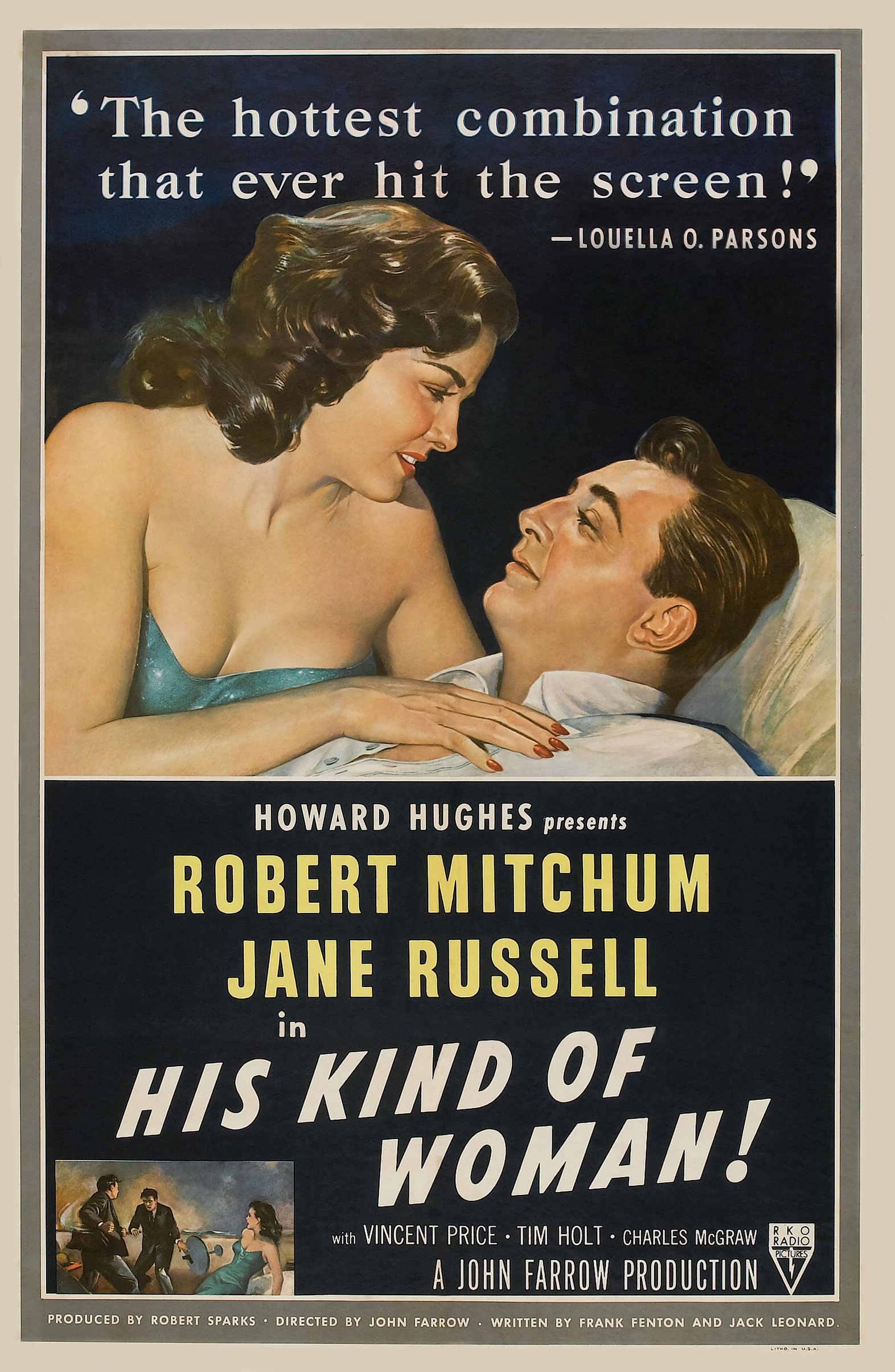
His Kind of Woman (1949; released 1951, John Farrow):
Jane and laconic co-star
Robert Mitchum demonstrate great on-screen chemistry in this fast-paced and offbeat adventure/comedy/noir. The somewhat convoluted plot involves a deported gangster (
Raymond Burr) attempting to sneak back into the U.S. by kidnaping and killing Mitchum and assuming his identity through plastic surgery. Jane is a down-on-her-luck saloon singer who meets Mitchum at the posh and remote Mexican resort where most of the action takes place. (Jane gets to sing the catchy if rather irrelevant theme song, "Five Little Miles to San Berdoo.") Burr, in pre-Perry Mason days, is a frighteningly evil heavy; Vincent Price is excellent as a hammy movie actor who tries to use his swashbuckling persona to help rescue Mitchum; Tim Holt is an earnest, pipe-smoking, but ultimately reckless G-man; and Marjorie Reynolds is amusing as Price's long-suffering wife. This well-written and mostly good-natured romp belies the fact that producer Hughes lavished a huge budget on the production and ballyhooed its premiere with fifty-foot, pyrotechnically enhanced images of Jane and Mitchum that reportedly created fire hazards along Hollywood Boulevard, and that Mitchum and Russell both despised director Farrow, whom Mitchum in a later TCM interview branded as a "sadist." Maybe there was something to Mitchum's claim: late in the picture, Jane gets locked in a closet for nearly a reel while Burr menaces Mitchum on his yacht with, among other things, a hypodermic needle (Hughes teamed Jane and Mitchum again in 1952 in the uneven "Macao," which was completed by Nicholas Ray after Hughes, as was his wont, fired original director Josef von Sternberg).

Hughes loaned Jane to Paramount for these two highly successful western parodies that paired her with comedian Bob Hope. Big budgets, Technicolor, songs (including the Academy Award winning, "Buttons and Bows," which is reprised with special lyrics in the sequel), and plenty of slapstick humor. Of the two, I prefer "Son," which has Roy Rogers as the third lead for good measure; and leave it to ex-animator Tashlin to throw in "boing" sound effects as Jane sways her hips while singing "Wing Ding Tonight."
Now, two more that need to be taken in smaller doses, but which typify (and, let's face it, objectify) Jane as a Hollywood "product":
The Outlaw (1940; released 1943 and re-released in 1946):
Produced and directed by Howard Hughes. Jane's notorious screen debut, this bizarre western was critically dismissed, but critic David Thomson has astutely noted that it is "very funny, very sexy, and as much Howard Hawks [whom Hughes initially hired to direct but later fired, taking over direction himself] as Howard Hughes." Jane seems to be in on the joke and demonstrates a screen presence that rises above director Hughes's outlandish focus on her breasts. Ironically, despite such overt fetishism, the male characters, Wyatt Earp (Thomas Mitchell), Doc Holliday (Walter Huston), and Billy the Kid (Jack Beutel) often seem as interested in one another as in Jane. I wouldn't go so far as to call "The Outlaw" good, but it's not as bad as is generally thought and worth slogging through with a sort of cultural anthropologist's eye.
The French Line (1954, Lloyd Bacon):
Not for the faint of heart, this bloated Hughes technicolor musical production was shot in 3-D (you guess the rest). I wouldn't recommend trying to sit through it, but those who are curious to see how baldly Hughes feinted at the 1950s censors may want to go to YouTube to see Jane's numbers, including "
I'll Be Switched" (in a bubble bath) and the rather alarming "
I'm Looking for Trouble." Jane must have had a great sense of humor (and a fantastic salary) to weather all this. Gilbert Roland is Jane's love interest and a woman who may be a very young Kim Novak (this is still debated) can be seen in the chorus in several production numbers.
Jane tried her hand at producing a starring vehicle for herself in 1957, "The Fuzzy Pink Nightgown" (Norman Taurog), but the comedy about a movie star kidnaped by a gangster was not a success. Jane turned to a nightclub and recording career, making movies only sporadically, including a cameo in 1966's "Billy Jack" (!); in the early 1970s, Stephen Sondheim tapped her to replace Elaine Stritch in his Broadway musical "Company," where Jane sang Sondheim's "The Little Things You Do Together."
 |
| Russell with composer Stephen Sondheim |
Her famous body and sense of humor still very much intact, Jane later became TV commercial spokeswoman for Playtex bras, designed for, as she put it, "us full-figured girls." She may not have made as much money from these ads as, say, Alec Guiness did from his percentage of "Star Wars," but there's still cosmic justice in Jane's being able to profit in middle age from her famous screen image of 20 years earlier. If you want to see what all the excitement was about, and how good Jane was in spite of all the hoopla and the frequent indignities of the era, have a look at some of the movies mentioned above.
Good Ol', Dear Ol' Dad
Hope you all enjoyed this first in what I hope will be many future columns written by my favorite dad.
PS: If you haven't yet watched "
Coffee Time", it's well worth watching!