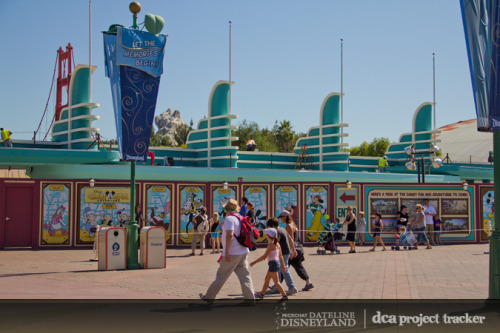
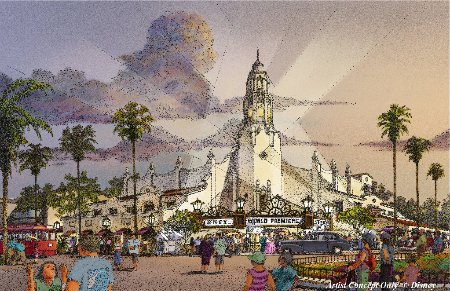
It was exactly one year ago that work began on Buena Vista Street, the newest addition to Disney's Califonia Adventure. The plan is convert the nondescript Walt Disney Plaza into a recreation of Los Angeles when Disney himself arrived there in 1923. Here's a 3D rendering of what the finished themed entrance will look like:
This is the latest in a series of changes to the park; making up a $1.1 Billion renovation of the park, with minor changes to Golden Coast and Hollywood Pictures Backlot (now Hollywoodland), a total re-haul of Paradise Pier and Walt Disney Plaza (soon to be Buena Vista Street), and even an entirely new area for the theme park: Cars Land, based on Radiator Springs and the entire cast of Pixar's "Cars". These changes come just in time for the park's tenth anniversary and are set to be completed just after the celebrations in 2012.
Satellite image of the original entrance and the new entrance blueprint.
Disney California Adventure had been expected to be a huge success; Disney executives fully expected to have to turn away visitors but were sorely disappointed by attendance in the first months and years after the park's opening. This major renovation is a direct result of California Adventure's struggles to keep up with it's next-door neighbor, Disneyland.
An in-progress photo with the intact Golden Gate in the background.
Paradise Pier has already completed its transformation into an early 20th century boardwalk, as opposed to the disjointed, pier theme park it originally was. Complaints arose when the park opened that this section of the park, in particular, seemed cheap, cookie-cutter, and like something you could find in any other 'ordinary' theme park. Although many of the changes were cosmetic, the addition of two new rides (Toy Story Midway Madness and a dark ride based on The Little Mermaid) and the unprecedented "World of Color" hydrotechnic experience have ultimately made the renovation worthwhile so far.
Part of the World of Color show
The Buena Vista Street project is not quite as ambitious, without any planned rides save a vintage-style trolley that will take guests from the entrance directly to the foot of the Tower of Terror. Both the miniature Golden Gate Bridge and the California Zephyr train are being replaced with more in-theme decor. In what was once 'Sunshine Plaza' - the hub from which guests could enter all the different lands - a replica of the Carthay Circle Theatre (where Snow White premiered in 1937) is in the works. It looks like Oswald the Lucky Rabbit might even get a nod with his own gas station in the main square (Who's Oswald? Find out next Friday). The new art-deco entrance gates were completed this past July, and most of the renovations should be ready sometime this fall.
Artist's Rendering of the Central Plaza with the Carthay Circle Theatre
Cars Land will feature several new rides, including one based on Test Track in Epcot. Construction of this and the other lands can be seen on Google Maps.
Concept Rendering for Radiator Springs
Ultimately these changes should serve as a pick-me-up to the down-on-its-luck California Adventure. Seems like the 1.1 Billion are being put to good use - Disney is directly addressing many of the complaints made by guests: a lack of attractions, poor theme cohesion, and a general absence of the 'Disney touch'.
A maquette for the statue of Disney to be placed in Buena Vista Street
I have yet to visit either of the Anaheim parks, but these additions make the idea all the more tempting.
When I first visited Haiti in May of last year I went with - among other things - the express purpose of coming back with a harrowing article for you all. Something about the cruelty of fate or the human condition. Like a CNN Special Report sans the Anderson Cooper. Yet, after an entire summer of contemplation and even a second visit, I still have very little I can say. My impressions and feelings are difficult to vocalize.
Above all, Haiti is a melting pot filled with bizarre juxtapositions, contradictions and non-sequitors. Take, for instance, the man in the "Harvard Law" t-shirt who sells bread on the corner, or the lonely Domino's Pizza sign standing in front of a vacant field. Take Port-au-Prince, with a Colonial Church looming eerily over a neighboring tent town; Take the Texaco gas station in a city seemingly paved with built-in potholes.
Haiti is a bizarre dreamland where nothing quite is as it seems. It's like wearing a shoe and being unsure if it's too big or too small, or hearing a chord with a stray sour note. I am more than anything just flat out not sure what to make of it.
I remember sitting by the pool at my mother's house in P-A-P this past weekend. I happened to be staring vacantly at the wall that divided our and our neighbor's yards, and I suddenly noticed that the bricks weren't overlapping. It struck me as odd because I didn't understand what reason the builders would have for doing that... I don't believe it's that much cheaper to build walls like that, though I guess it might be slightly easier... If this was the standard for other construction it's no small wonder that the country was so completely devastated by a large-scale earthquake. Thankfully, after the earthquake the Embassy took the time to inspect all of their still-standing structures to make sure they were up to American code
One of the more festive shops...
Having had both parents assigned to Haiti and having visited twice, I've heard a lot of the stories of what happened during and before the earthquake. One woman had just received a guest into her home and was giving her tour. As they stepped out into the garden, the earth shook and the house collapsed behind them. In a different part of town the Embassy had rented out a two-story apartment complex. At the time of the earthquake this complex was empty; all of its residents were on shuttles headed home from school and work. They arrived to find their homes pancaked into the street. In a condo neighborhood just recently completed before the earthquake, witnesses reported watching the peripheral security wall wobble as if made out of Jell-O.
The country was already in such difficulties that this wrench in the gears should have just completely destroyed the machine. Hell, here in the "civilized" world we start riot over sporting events. Yet these people don't turn over your car in the street.
One of the major problems during the earthquake relief effort was that the tent cities being built in and around Port-au-Prince were being populated by people who hadn't lost their homes in the disaster. They saw food and shelter being given out on a daily basis and decided to take advantage of the situation, cheating those who most needed the aide. I don't consider them to be bad people. It was simply a matter of desperation
"Jesus Christ is coming to take the chosen ones, 21 May 2011"
What truly left me in awe after my visit was the resignation of the Haitian people. I spoke to a middle-class Haitian who jokingly said they "only complain when things are good". Where they find the strength to wake up every morning and say, "I'm going to go out into the streets and walk until I sell all of these mangoes," is a complete mystery to me. Their faith is certainly strong. That's easy to see in the names they give their "buses", which they call "tap-taps" and are any variety of re-purposed auto, most commonly a pick-up truck with an added seating area. "Merci Man Man Marie" (Thank You Mother Mary), "Dieux Tout Capab" (All-Capable God), and "Romains 12 v12" (Romans 12:12). These names also find a place in the huge grass-roots lottery industry - another sign of their faith in Fortuna.
"Be joyful in hope, patient in affliction, faithful in prayer."
I think that quote really sums up the Haitian people right there. They are proud, faithful, and resigned to do their best in their circumstances, and their situation doesn't seem to be getting much better, even with a new President. Martelly has expressed his frustrations with the Haitian government, where funds to build housing for the poor are locked away, but he could immediately begin work on a summer home for himself if he so chose. Haiti is basically run by twelve wealthy families who control the government and all major industry in the country. It's a modern-day oligarchy with a Democratic mask - and what a mask! Members of the Haitian Congress receive a salary of $10,000 US per month, which you can imagine is an obscene amount of money to have in a country so poor.
What's even more bizarre is the series of contributions Haiti has made to History that few are even aware of. Infamous buccaneer Jean LaFitte was born in Port-au-Prince around 1782 - he would later be largely influential in helping us win the War of 1812 in the Battle of New Orleans. Haiti gave Simón Bolívar the military and financial assistance that may have made all the difference in his fight to liberate New Granada (which we know today as the countries of Colombia, Ecuador, Panama, and Venezuela). Throughout the 60s and 70s, Haitian doctors, professors, and other intellectuals who fled the tyrannical rule of François "Papa Doc" Duvalier contributed significantly to the development of former French colonies in Africa. So, what happened to Haiti?
The hole in the middle of the square was once a police booth, torn down because it was haunted.
Consider their Eastern neighbor, the Dominican Republic. Comparing Gross Domestic Product, The DR comes in at around $93 Billion, while Haiti trails behind at not quite $11 Billion. Haiti is nearly half the size of its neighbor but has a slightly higher population. On the Human Development Index (which measures relative living standards), the DR scores 0.663 (medium) and Haiti only 0.404 (low). I think ultimately the problems stemmed from squabbling factions and the country's inability to maintain the economic strength it had before its independence that was supported by the 90% slave population.
Of course, we could sit here and ponder and muse all day long over the reasons for Haiti's trouble and still the people of Haiti would be living in tents. The most we can do is support programs that help Haitians and others like them around the world. Ultimately, though, it's up to the Haitian people to take fate into their own hands, because no amount of international intervention can change the hearts of a people resigned.
There is a popular Haitian proverb that says "Dye mon, gen mon," behind every mountain is another mountain. It means that no matter how many obstacles we overcome, there will always be more to face in the future. Perhaps it's not about fighting the circumstances you're in, but about making the best of them, and perhaps, in that sense, the Haitian people have it all right?
As I've mentioned a few times since I made over my blog, I've officially offered my advice to anyone who has questions regarding etiquette and manners (Ask a Gentleman) and costumes, sewing, and theater (Ask a Costumer). After looking through my first few responses, I chose the following e-mail from a close friend:
Dear Nostalgically Yours,
My boyfriend's godmother died yesterday (it's okay, she's had terminal cancer for 10 years and just started to fade this year so they knew it was coming) and the funeral is on Friday. I'm not 100% that I'm attending, [her boyfriend] says he doesn't want me to have to go to a funeral while I'm here [...] but anyway, I don't know what to wear! Since I'm here in Europe visiting, I'm very limited on what I have, so I need your opinion.. I was thinking black dress with black leggings, and then I have a grey lace blazer and my green suede heels. They are the only heels I brought so I don't know if they work, but I don't know if flats or my grey suede boots are appropriate? It's pretty traditional here as far as funerals, and [her boyfriend] is wearing a suit, tie, and dress shoes.
I've only been to two funerals and my grandma didn't want any of us wearing black to our grandpa's funeral, and at my friend Alexis' funeral, no one wanted to wear black because it was already sad enough, so I really don't have a lot of experience.. I also have a black high wasted skirt I could wear again with leggings because I don't think showing legs would be appropriate, [...] with a black sweater so I'm not showing my shoulders, and the green heels. That's another option I was thinking about. [...]
His sister is coming here with his dad to get his dad something to wear so I'll ask her what she thinks ([...] she will be able to tell me if i need to be in all black or not). It will most likely me slightly chilly so the blazer would be fine. [...] I'm thinking I will most likely go with the boots but like I said, I will get another opinion from his sister.
Thanks a bunch,
Hopelessly Under-packed
Dear Hopelessly Underpacked:
Whereas even fifty years ago the etiquette for events such as funerals and weddings were clearly marked by your culture and country, today it is extremely difficult to tell exactly what to wear to these sorts of things to avoid offending anyone. This is especially true about funerals - anything involving the death of a loved one is bound to make family members high-strung already, so the last thing we as guests of the funeral party want to do is make a spectacle of ourselves. Luckily there are still some general guidelines one can follow when having to go it alone, or when wardrobe is limited, such as it is in your case.
Your first instinct in terms of modesty are correct. It is inappropriate to show too much skin at a funeral, so if you must resort to wearing something shorter than knee-length, you should at least cover your legs. Shoulders and hair are generally acceptable in most situations, especially during the summer months, but it is important to double-check with the family and/or the location of the religious service to ensure there are no modesty requirements. Though I'm not worried about this with you, "H.U.", I will remind anyone else reading that cleavage is never acceptable at a funeral. Strapless dresses are also generally frowned upon.
Color is an issue that can vary widely. Though this doesn't apply to you, some Eastern cultures wear white to memorial services and funerals. As you mention in your e-mail, color can vary greatly depending on the deceased and his or her family. Though it's generally best to stick to black, grey and white, if a family member gives the okay for other colors, by all means go ahead. For your specific situation, "H.U.", I would nix the green suede pumps in favor of your flats or boots in neutral colors. More conservative crowds will find colorful accessories or bold prints to be disrespectful.
Since we know each other, I have trust in your taste. My only pieces of advice are to keep it covered, keep it simple, and keep in touch with the family.
Ladies and Gentlemen, Good afternoon and welcome to Post number 74 headed to Nostalgia and Thoughtfulness. Emergency exits are located in your task bar and in the big red "x" in the upper right hand corner of your window. We ask that you kindly take your seats and make sure that Facebook is safely stowed in another tab or under the seat in front of you. All electronic devices must be turned off at this time, except for the computer or mobile device you are using to read this entry. Thank you, and enjoy the flight.
A century ago, everyday people such as you or I would never dream of sitting in giant metal flying machines, being hurled across the country at thousands of miles per hour. One hundred years ago, the words "airport" and "airline" were almost completely unheard of. In 1910 we could never in a million years have fathomed a situation as unpleasant as the Steven Slater JetBlue incident.
At the dawn of the last century, just before the first world war, the only ways to travel were by train or boat. Neither cars nor planes were considered objects for extended travel. In fact, planes were still just odd scary contraptions that were used in spectacles and air shows. Comfort and safety were unheard of in these early flying machines. It was not until the Great War broke out that planes were seen as viable tools of war and were taken seriously. The twenties saw the beginnings of Air Mail and Air Travel, though passengers came second to the mail cargo. Finally, the Ford Motor Company bought out an aircraft manufacturer in 1925 and began producing 12-passenger "Ford Trimotors", and just like that airline travel was born.
Until the end of World War II, airline travel was successful, but not in any huge scale. Air travel was still relatively dangerous and expensive, so it was reserved only for a select few. The late forties through the seventies were the golden age of Air Travel. This is the same life-span that the Flight Stewardess lived as a sex symbol:
Note the glasses and how the food cart actually fit down the aisle without killing anyone.
This was also the Golden Age of Legroom and Comfort:
Here's another, much longer clip you can skim through. It's another glimpse into a very different time. I really got a kick out of seeing the "modern" communications technology they kept touting throughout the first half of the film:
Not by coincidence, the rise of the airplane saw the end of the golden age of ocean liners. Ships became too slow for Jet age travelers, so more and more they opted for a small sacrifice in comfort for a huge boost in speed. As a result ocean liners were turned mostly into a vacation industry now that the transatlantic crossing could be achieved in a few hours instead of a few days. More on this later. It was also around this time that trains and buses began to suffer huge losses because everyone was taking planes. Naturally it follows that inter-city bus lines began shutting down and the train system was simplified to carry mostly freight. Now, I have nothing against air travel in principle, but pretty soon the airplane literally became the only way to travel... As demand for air travel increased, it killed other modes of transportation, which in turn created more demand for air travel - it had become a vicious cycle which continues to this day.
At the peak of the Jet Age was the Boeing 747 - the Jumbo Jet. These would have been quite a site to behold. Even the steerage accommodations seem more comfortable:
Ironically, this also marked the end of the good old days. The American deregulation of airlines starting in 1978 was what eventually created the modern airline experience. Once economic downturn hit in the 80s, most of the major airlines were bought out by large conglomerate corporations just as a slew of small airlines began emerging thanks to the deregulation. The newer companies couldn't compete with the big money, and were mostly stamped out. More people were flying, and the parent companies wanted to increase their profits, so they had designers fit more and more seats into their planes, including the 747 which is still used today.
So, air travel was getting pretty cramped, no big deal right? Companies have to make a profit off their investments, don't they? It's part of the deal, isn't it? Just wait. There's more.
After the attacks that occurred on September 11th, 2001, security in airports and on aircrafts increased dramatically. Which is completely understandable, considering the circumstances. However, when you have to wait in line for half an hour, take off half your clothing, and throw away half of the contents of your carry-on, the least you could possibly expect from the airline is to be treated like a human being. Now, though, in the wake of the 2008 Economic Collapse, airlines have cut the most basic of services.
My grandmother used her miles to upgrade to First Class on a flight between Bogota, Colombia and Washington, DC. They had no blankets, no pillows, not even a newspaper... in first class!!! Have you noticed that we are no longer "passengers", but are instead "customers"? Listen to the gate attendants next time you're waiting for your flight. They will call you "customers". This is the exact problem with air travel today. Instead of passengers to be treated with respect and dignity, we are customers to given the run-around on an automated voice system when we try to call them.
This customer vs. passenger issue stems from a mindset we were put into in the 1980s - where low prices supersede good value. As long as the price is low, the true value of the item is meaningless. This is the mindset that allows airlines to manipulate us. We think that spending more money for a better product is bad, so we're willing to sit through hell just to get where we have to be. That's how companies make money billions of dollars off of us. They produce to the cheapest possible product to sell at a moderately discounted price and remind us that paying less for something is more important than getting what you pay for. Now, I'm not saying you should go out and splurge on a thousand-dollar ticket for a fully reclining cocoon-seat, but airlines can't make these changes for free. If we want better service we'll have to be willing to pay for it. Luckily, interest seems to be turning toward a new standard of comfort. Check out these commercials for the 2011 Toyta Avalon:
Companies are using these nostalgic memories as a standard for excellence - as they should! The standards of the time were much higher. People believed that comfort and service were just as important as convenience and cost. Today convenience and cost dominate the human psyche, so we have people like Steven Slater and Bonquiqui:
Which of these ladies would you rather have as a flight attendant?
It's kind of strange to think about, but wouldn't you agree that cars are generally more comfortable than airplanes? I recently drove from DC to New Orleans and I did not get the least bit tired of sitting in my Jetta for the two-day journey, whereas two hours on any plane is more than enough to keep your neck in a crick.
Anyway, I hope those commercials are a sign that things are changing. Maybe people are starting to understand that everything shouldn't be about the price. More and more airlines are including options like "Economy Plus" on United Airlines which features more legroom. Basically, the more people buy the slightly more expensive seats, the more legroom people will have in general. You can't expect big companies to do these things themselves. These companies will only make decisions based on bankroll. So, logically, if we as travelers show a demand for better seating and service, and show that we're willing to pay a little more for it, we'll get what we want. The only other answer would be to threaten their bottom line, which is basically impossible since other options are now so limited. If you want to travel you simply can't boycott these airlines... What are you going to do? Take a boat?
Perhaps instead of blaming Slater for his actions directly (though he is responsible), JetBlue and the entire Air Travel community should look inwardly and see that Slater's outburst has its roots in the problems created by the airlines and their parent companies. Perhaps instead of seeking to increase dividends, companies should work to enhance the travel experience. At the same time, if we expect these changes to occur, we must look inwardly and change our mindset to be prepared to pay for what we ask for. After all, the only language these companies speak is money.
Ladies and Gentlemen, we have arrived at the end of this post. We hope that your journey was to your liking and that the next time you need some reading material you'll keep us in mind. Please use caution when clicking the links to older posts in the sidebars, as contents may shift your interests and prevent you from leaving this website. Once again, thank you for flying with us.
Nostalgically Yours
If you enjoyed this post, you might also like reading some posts on old-fashioned travel on David Toms' blog Savoir Faire. Just don't forget to tell him who sent you!