Showing posts with label Law. Show all posts

Tuesday, May 8, 2012

Food For Thought - Beyoncé's "Countdown"

It seems that Mrs. Beyoncé Knowles-Z has decided that her entire career is going to be dedicated to providing fodder for my blog posts. I don't have a problem with that, I'm just sayin'... This time it's her new video for Countdown:


For me, the most obvious inspiration is right here:


Yes, everyone remembers that famous Gap commercial that features Audrey Hepburn dancing (but not wearing Gap clothing). Fewer people remember where that footage of Ms. Hepburn came from:


That dance comes from Funny Face, one of my all-time favorite movies, and clearly also one of Beyonce's, as she's drawn inspiration from it before. The outfits of the musicians match those of Hepburn's backup dancers, and even the layout of the bandstand shots mimics that of the nightclub set from the movie. The dancing, however, doesn't match. It clearly took me too long to write this article because just in the week or so since I began researching this article, there has been an explosion of press regarding similarities between "Countdown" and the choreography of Anne Teresa De Keersmaeker. To see a side-by-side comparison of De Keersmaeker and the music video, click here.

"Achterland", left, "Countdown", right.
Left and right, Beyoncé is being accused of stealing the choreography from De Keersmaeker. So much so that Knowles decided to release an alternate version of the video that excluded all of the controversial footage. Even De Keersmaeker herself had some things to say  about the music video, though she seems kinder than most. This is similar to the criticism rained down on Lady Gaga every time she does anything that even remotely resembles anything Madonna has done. Because Madonna has never, ever imitated anyone herself, right?

Right?
If you're like me, you were incessantly lectured about plagiarism in school (if you're really like me, you worries about being accused of plagiarizing even after taking every precaution to avoid it). What were the things we were told to do to ensure we weren't plagiarizing someone else's work?
  • Re-write the information in your own words.
  • Use multiple sources.
  • Credit the author(s) of the work.
Knowles has done all but one of those things- she took the parts of the dances she liked and changed the context; she set it to different music and put different bits of the choreography together. De Keersmaeker has pointed out that even though they are performing the same dance, what Knowles and her dancers are doing is distinct from the films they mimic because of their context:

"In the 1980s, this was seen as a statement of girl power, based on assuming a feminine stance on sexual expression. I was often asked then if it was feminist. Now that I see Beyoncé dancing it, I find it pleasant but I don’t see any edge to it. It’s seductive in an entertaining consumerist way."
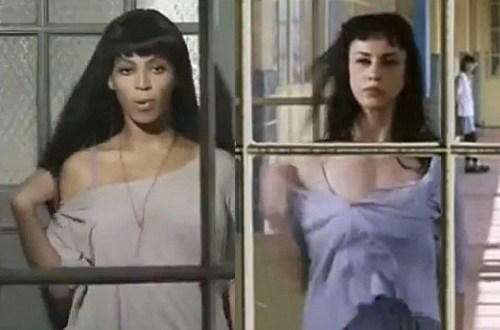
"Countdown", left. "Rosas danst Rosas", right.
Knowles also took inspiration from all kinds of other sources: Op art, Pop art, Mary Quant, Whtiney Houston... even Gap commercials! All of these things together created a unique work that is separate from all of its inspirations yet tied to them at the same time.


Now, I do believe Knowles and her team should have credited De Keersmaeker since they did borrow so heavily (and directly) from her, especially since they credited Boyz II Men after sampling from their song "Uhh, Ahh". However, according to a GQ interview with the video's director, Andria Petty, it was the team's intention to credit her but they overlooked this due to the tight deadline.

Can you say Andy Warhol?
This isn't the first time Knowles has borrowed heavily from others, nor will it be the last. This is also not the first time this sort of happened in the music video industry, nor in the music industry at large. Paula Abdul's "Rush Rush" is basically "Rebel Without a Cause", and Madonna's "Express Yourself" is basically "Metropolis". Music sampling has existed for decades. "Ice Ice Baby" sampled from "Under Pressure", "Rapper's Delight" sampled from "Good Times", "U Can't Touch This" sampled from "Super Freak"... The list goes on and on... If artists can't borrow from each other or imitate or build upon the work of others, then art cannot advance.

Knowles in Thierry Mugler
In addition, Beyoncé used the choreography to a different end than De Keersmaeker. The original footage was a work of choreography. It was a dance film. Knowles was presenting a video for her song. She was not presenting a dance, she was presenting a music video.


Finally, I think this whole climate of ideas as property contributes to rise of dangerous legislation such as CISPA. If we continue to consider artistic ideas as property in every context then we will be left with major corporations holding a monopoly on creativity because they're the only ones with the money to consistently defend "their" properties. We need to chill out about these kinds of things and start worrying about bigger problems.

Hope I haven't completely chewed off your ears!

Friday, May 6, 2011

Food for Thought - Lady Gaga and Madonna

Yesterday, pop culture icon Lady Gaga released the video to her latest single, "Judas".

Normally, this would be outside the scope of my blog, since I deal mostly with vintage or nostalgic elements. However, there is a nostalgic slant to this story. In addition, this would normally be dealt with on Music Mondays, but I felt it deserved a more in-depth article than those I do for music videos.

The main controversy surrounding Mother Monster as she is called by her fans (myself included) and her new album "Born This Way" is that the title song - the first single released from the album - sounds suspiciously like one many people remember from Madonna's album "Like A Prayer". If you follow pop culture at all you will have heard in the weeks and months since the release of "Born this Way" many call-outs on Lady Gaga for the song's striking similarities to "Express Yourself".


How does she plead? Not guilty. In an interview with NME she called claims that the video was a rip-off of Madonna's "Express Yourself" ridiculous: "If you put the songs next to each other, side by side, the only similarities are the chord progression. It's the same one that's been in disco music for the last 50 years."

There are many differing opinions on the matter, mostly falling into the camps of "guilty" or "not guilty". Personally, I feel that either of these views are overly simplistic and cannot really address the issue as a whole. Plagiarism is something we've dealt with a lot as a society since the Information Revolution of the 1990s. The Internet has made it much easier to share and/or steal both ideas and intellectual property. Most of the debates regarding the Internet over the past ten years have been about protecting copyrights for musicians, photographers, publishers, etc.

In a 2002 exposé on this subject and its appearances in the fashion world Cathy Horyn, New York Times Fashion Critic (who made a guest appearance at my school this past week) asked "Is Copying Really a Part of the Creative Process?" To summarize the article, she took the example of designer Nicolas Ghesquière's apparent "lifting" of a designer vest from the 70s in his Spring 2003 Collection (see side-by-side here

The original on the right and the copy in Balenciaga's Spring 2003 show on the left.

A quote from the article:


"''I think it's a phase of our time,'' said Harold Koda, the costume curator at the Metropolitan Museum of Art. ''Part of it is post-Warhol. It's just rummaging through extant material culture and juxtaposing it with other things to create something different. Postmodernism has really pervaded our culture.''"


Another quote:


"Mr. Wong [Kaisak Wong's brother. Kaisak died in 1990] knows about the Balenciaga copy. ''Is it like plagiarism?'' he asked. Copyright laws don't cover fashion as they do publishing and music -- nor should they, said Lawrence Lessig, a Stanford University law professor. ''We borrow and change -- that's the creative process,'' he said."


We can understand two things from these quotes: first, that in the modern artistic climate we borrow from others in order to create and second, that in order to avoid plagiarism, we must take what we borrow and make it our own. There is little doubt that Ghesquière's actions were, in fact, plaigarism, since he took an existing design and changed only the actual fabric - not even the type of fabric, but did Lady Gaga do the same thing?

Even if we consider that she "lifted" the melody for "Born This Way" from "Express Yourself" (which I don't really believe, though I do see strong similarities between the two songs), she changed the lyrics, cadence, rhythm, and message of the song entirely. Even if she "borrowed" the melody she still took it and made it her own. This is not copying, this is the postmodern creative process.

I'm sure some of you are out there saying that Gaga's Madonna get-up at the end of the "Born This Way" video proves the accusations of plagiarism. However, we must remember that these allegations had been bandied about even before the video went into production. Being Lady Gaga and enjoying ironic commentaries, she naturally wanted to reference the similarities in an irreverent way. This was how she did it:

Two stills from "Born this Way" showing the Madonna look.

Here's the part of my article that I think is really cool. For the first time I think I may actually have a somewhat legitimate scoop. I don't know exactly how many of my readers were alive when "Express Yourself" was first released, but I wonder if the media at that time made any references to this song when Madonna's hit came out:


Skip to the one minute mark and I'll wait for you to pick your jaw up off the floor. If there is any plagiarism going on in this situation, the guilty party is Madonna. Unlike "Born This Way" to "Express Yourself", here the chorus is melodically identical to its predecessor.

However, do I actually think Madonna is guilty of plagiarism? No. I don't. To be frank I don't think that either of these women are guilty of copying something. Did they borrow as part of the creative process? Maybe, but I am a strong believer in Zeitgeist and the philosophy that ideas don't really belong to one person or another and instead exist all around us. It is those who take those ideas and create something uniquely his or hers who can then claim the product as their own.

An artist can be inspired by a tree and choose to paint it. Does this mean that he owes the tree a royalty check? If a designer (say Yves Saint Laurent) is inspired by an artist (just picking names out a hat here.... Mondrian) and creates a dress that maybe kinda sorta looks something like this:


Would that make Monsieur Saint-Laurent a plagiarist or a genius? Whether or not he owes royalties to Mr. Mondrian is a question of legal procedure. This is a philosophical debate.

Very little of what we create comes from thin air. A good example of this is explained in a theory about dreams - that we can only dream about people or places we've seen in real life. This makes sense to me, despite what some of you have just shouted at the computer in disagreement: "What about that dream I had where I was in a land made of cotton candy/a place I've always wanted to go but have never been to/a place that did not exist in my lifetime?!?" Simple: We take elements from what we see every day and mix them all up in our heads to create new places. We might take the grass from our backyard and the mountain range from that travel magazine you flipped through at the doctor's office. The toaster in that tree came from the Highlights under the travel magazine. The key here is the creative combination or alteration of these basic elements.

"OMG they TOTALLY ripped of Highlights!!!1!!"
You can also think about it this way: Most people know that mythical creatures are based on misunderstandings of real animals. Think about how the ancient people tried to explain them. Someone who has never seen a rhino before and who has no word for rhinoceros in his language would naturally, upon returning to his tribe, explain what he saw as a horse with a horn.

What I'm trying to say - in a rather roundabout way - is that it's practically impossible to be completely original. All ideas come from somewhere outside ourselves. The challenge is finding an original way of expressing those ideas and creating a product therefrom.

Adding a drum kit to an extant song does NOT count.
Madonna and Lady Gaga have both done this indirectly. Gaga has admitted that she is a huge Madonna fan. There was likely some indirect inspiration there. Did she sit down with the sheet music to "Express Yourself", change three notes and release a new song? No. MOVE ON. Madonna probably heard "Respect Yourself" growing up. Maybe she felt that chorus could be taken in a new direction or maybe that phrase just stuck in her subconscious and came out as a new song. Did she sit down one day and say, "Gee, I think I'll rip off talented artists and make gobs of money off of their hard work"? No. That job is already taken (I'm looking at you, Forever 21).

I wish I could say that we've moved on from this controversy, but people are already comparing "Judas" to Madonna's "Like a Prayer", saying there are similar religious overtones and bla bla bla. It's kind of irritating. In En Vogue's "Free Your Mind" they feature a spoken introduction just like "Express Yourself". Are they plagiarists, too? As a society can't we learn to concentrate our energies on debates where there is, in fact, plagiarism going on? (I'm still looking at you, Forever 21).

Think about it,

For more on intellectual property, see this post.
Enhanced by Zemanta