Showing posts with label customs. Show all posts

Wednesday, March 2, 2011

The Good Wife's Guide


The "original" - but don't read it! I have it all below.
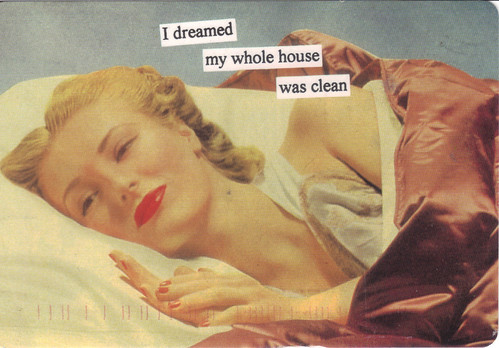
Allegedly an excerpt from Housekeeping Monthly, this "Good Wife's Guide" has been circulating the internet since it's inception. Some say it was even sent around by fax before e-mail took off. Most experts have discredited this article as little to no proof of its original publishing exists. However, I personally believe the advice in this article to be somewhat reflective of the time period. If you want proof, just watch any episode of "I Love Lucy", or films such as "Crime of Passion" (1957) or "All that Heaven Allows" (1955). Life for the average housewife was quite depressing, and strict gender roles paired with a cash flow coming exclusively from the husband did nothing to help. Anyway, I thought I had already done a post about Anne Taintor, but apparently I was mistaken, so I'll leave the info about her for another post and simply accompany this delightful little guide with some of her artwork.


  • Have dinner ready. Plan ahead, even the night before, to have a delicious meal ready, on time for his return. This is a way of letting him know that you have been thinking about him and are concerned about his needs. Most men are hungry when they come home and the prospect of a good meal (especially his favourite dish) is part of the warm welcome needed.
  • Prepare yourself. Take 15 minutes to rest so you'll be refreshed when he arrives. Touch up your make-up, put a ribbon in your hair and fresh-looking. He has just been with a lot of work-weary people.

  • Be a little gay and a little more interesting for him. His boring day may need a lift and one of your duties is to provide it.
  • Clear away the clutter. Make one last trip through the the main part of the house just before your husband arrives.

  • Gather up schoolbooks, toys, paper etc and then run a dustcloth over the tables.
  • Over the cooler months of the year you should prepare and light a fire for him to unwind by. Your husband will feel he has reached a haven of rest and provide you with immense personal satisfaction.
  • Prepare the children. Take a few minutes to wash the children's hands and faces (if they are small), comb their hair and, if necessary, change their clothes. They are little treasures and he would like to see them playing the part. Minimise all noise. At the time of his arrival, eliminate all noise of washer, dryer or vacuum. Try to encourage the children to be quiet.
  • Be happy to see him.
  • Greet him with a warm smile and show sincerity in your desire to please him.
  • Listen to him. You may have a dozen important things to tell him, but the moment of his arrival is not the time. Let him talk first - remember, his topics of conversation are more important than yours.
  • Make the evening his. Never complain if he comes home late or goes out to dinner, or other places of entertainment without you. Instead, try to understand his world of strain and pressure and his very real need to be at home and relax.
  • Your goal: Try to make sure your home is a place of peace, order and tranquility where your husband can renew himself in body and spirit.
  • Don't greet him with complaints and problems.
  • Don't complain if he's late home for dinner or even if he stays out all night. Count this as minor compared to what he might have gone through that day.
  • Make him comfortable. Have him lean back in a comfortable chair or have him lie down in the bedroom. Have a cool or warm drink ready for him.
  • Arrange his pillow and offer to take off his shoes. Speak in a low, soothing and pleasant voice.
  • Don't ask him questions about his actions or question his judgment or integrity. Remember, he is the master of the house and as such will always exercise his will with fairness and truthfulness. You have no right to question him.
  • A good wife always knows her place.

With that, I must leave you. I did have that dream last night, and it has yet to come true. Must keep the house clean for my imaginary husband's return!

Photo credits:
All images used in this article are copyright Anne Taintor, save the Good Wife's Guide which is in the Public Domain.

Enhanced by Zemanta

Wednesday, June 30, 2010

Put on Your Sunday Clothes!

Most of you will recognize this song from "Wall-E", one of my favorite movies. As I explain in my review of "Toy Story 3", a Pixar movie will inevitably make me cry. Today, however, I weep only for the lost traditions of yore.


The song you just watched speaks to the lost western cultural phenomenon of "Sunday Clothes" (you've heard the expression "wear your Sunday best"?), when people would wear their best dresses and suits to Mass on Sunday morning. Obviously, this has its roots in Christian tradition, probably dating as far back as the Sunday "sabbath" in the time of Constantine I. Since the rise of Christianity, those who worked did so Monday-Saturday. Our modern concept of the weekend wasn't nationally accepted in the United until 1940 (Pioneers of the two-day weekend included Henry Ford in 1926). This meant that Sundays were all the more special for people, since it was their only day off. Though the leisure class could afford to dress lavishly on a daily basis, the working classes had only Sunday to look forward to show off a new dress, a new tie, a new hat. Depending on their income, after Mass most people would go out to the park, to the beach, to enjoy some sort of recreation and to further display how swell they looked. The idea of Sunday clothes is about more than just religion, it has to do with a sense of decency and decorum that went out with the Baby Boomers. Nowadays, being well-dressed is optional. People don't blink an eye if a person goes grocery shopping in sweatpants, but even fifty years ago people thought it was important to look well-kept and elegant.


On this vein, in a relatively recent article from the April issue of Southern Living, Valerie Fraser Luesse pines the loss of three classic icons of feminine propriety:


"1. The Easter Dress
We used to start shopping for out Easter dresses before the Valentine's candy was even stale. An Easter dress was your prettiest, dressiest Sunday-go-to-meetin' ensemble of the year. It screamed spring: floaty fabrics in pastel colors; short sleeves, puff sleeves, or no sleeves; store-bought or handmade. Pearls required. and glovesHat and gloves optional after 1960. [...]
2. The Mother's Day Corsage
When I was a kid, if a mother came to church without a corsage from her children, the whole family went on everybody's prayer list. Now almost nobody buys one, and that's a shame. Here's how it works. You choose the flowers for your mother's corsage based on whether her mother is living or dead. If her mother is living, she wears roses or carnations in pink or red. If her mother has crossed over, she wears white or yellow roses or an orchid. Everybody gets baby's breath. It's just the right thing to do.
3. The Hostess Apron
'When you saw my grandmother's mint-green organza apron, you knew some cucumber sandwiches were coming out,' my friend Rebecca says. Back in the day, Southern [and most other American] women wore kitchen aprons, which they actually wiped their hands on while they cooked, and hostess aprons, which adorned and protected their good dresses while they served guests."


I guess my upcoming move to New Orleans really has me thinking about long-gone nostalgia such as this. Southerners have a reputation for being much more old-fashioned than Yanks - and it's really true. a New Yorker sticks out like a sore thumb in the Crescent City. My last visit to NOLA left me completely flabbergasted. I wondered at the courtesy and warmth I encountered wherever I went. I'm excited about getting more in touch with my New Orleans past. My mother and aunt were the seventh generation born there. I'm also glad I inherited my family's Southern sensibilities, which is why I really agree with Ms. Luesse in that it's a crying shame that these and other traditions have been abandoned. Of course, as she also says in her article, certain things are better left in the annals of Good Housekeeping...


However, in our desperate attempt to do away with those things we saw as uncool and old-fashioned, we effectively threw out the baby with the bathwater. The Baby Boomers were so preoccupied with breaking down the establishment that they didn't stop to think about what might be nice to keep around. Eventually we reached today's generation - the new "Silent Generation". Not silent like the first one, because it had been assimilated by World War I, but silent because we're simply not involved in anything outside our Facebook accounts or our television screens.


The good news is that I think things are changing. Artists such as Katy Perry and Christina Aguilera have done a lot to try and modernize the looks of the 30s, 40s, and 50s, making it cool to look retro. Lady Gaga and Laroux are both intensely reviving the 80s. Hopefully this will encourage other young people to examine the lifestyles of days gone by and maybe start picking out and adopting the things that are relevant in the 21st century. This is especially true because I don't know if we've really found our voice as a generation (thus the "silence"), so perhaps in a world saturated with information, we'll begin to combine the past with the future in finding an identity of our own.


Here's Hoping!

Nostalgically Yours

Wednesday, June 23, 2010

Hat Etiquette

This morning I had a doctor's appointment. I felt like dressing up, so I wore a suit and my straw boater - this was unfortunately before I knew the temperatures were going to hit 80 before 10am... Nevertheless, I think I looked pretty snazzy. My father and I were in the waiting room, and he looked over and mentioned under his breath that I should remove my hat. Quietly, I wondered aloud if a gentleman really needed to remove his hat in what I considered a public place, but removed my hat to please my father.


I was already thinking a lot about headgear when something else hat-related happened. The nurse attending me gave me great praise for wearing my boater, and told me she wished all her patients wore hats regularly. This got me thinking of the legitimacy of wearing hats in the 21st century, and why we as a society choose not to wear them on a daily basis. Even fifty years ago a well-dressed man or woman did not leave the house without a hat. So what had happened?


Millinery and Haberdashery (women's and men's hat making, respectively) were very closely tied to Couture style fashion. With the rise of ready-to-wear in the 1960s, it became "uncool" to wear hats, since they were associated with the "old world of fashion. Nowadays, most people completely overlook the practical aspects of the hat.


Dermatologists agree that prolonged sun exposure speeds up the aging process. Wearing a hat protects not only from that but also from the UVB rays that are linked to skin cancer. Obviously, in winter a hat will keep you warm.


Another overlooked aspect of hat etiquette is the layer it once added to social interaction. In olden days, when a gentleman tipped his hat to a passing female acquaintance, it was not only a means of showing respect for the woman but could also be a subtle flirtation. A woman could flirt right back by playing hard-to-get under a merry widow.


Of course, the fashionable aspects of wearing a hat go without saying. Emily Post was quoted in 1959 as saying: "It is impossible for a hatless woman to be chic."


Well, I can definitely say that I am officially a hat person. My new goal is to collect hats and eventually be able to wear a hat whenever I leave the house. Because of this decision, and because I was still curious as to who was right between my father and myself, I did some research and found several accounts on hat etiquette from reputable sources such as Miss Manners and Amy Vanderbilt.


If I've convinced you that hats are not only healthy but are also a great way to express your sense of style, stick around for a brief lesson in hat etiquette. You'll be able to wear your hat next time without any embarrassing faux-pas! Before I explain hat etiquette, though, it is important to know some hat anatomy:


(A) Brim: This is the part of the hat that extends from the head, shielding you from the sun.


(B) and (C) Crown: This is the part of the hat that generally sits on the head.


(B) Hatband: This term applies both to the sides of the crown and to the decorative band of fabric on the hat.


(C) Tip: This is the top of the crown.


The last thing to know before I start is a little terminology. To don your hat is to put it on your head. To doff your hat is to take it off. Finally, to tip your hat is to grab the brim of the hat and either bow your head, or briefly remove the hat - both as a greeting or sign of respect.


For the Ladies:

Your rules for etiquette are really quite simple. You get to keep your hats on under any circumstances, even for the national anthem. However, if you choose to wear a hat that is considered "unisex" (like a baseball cap) then the rules for a gentleman apply. See below. I hope the above diagram sheds some light as to the "ladies' exception - women's hats traditionally cause more problems when being removed. Thus, she is never required to take it off.


For the Gentlemen:

Your rules are much more complicated, so if you want to know all the dirty little details I've provided a link in the sidebar. I'm just going to cover some basics here. Generally speaking, if you're outdoors or in a public place (such as a lobby or waiting room), your hat should stay on. When passing a lady outside, a gentleman need only tip his hat if he addresses the lady to say such things as "good morning", "hello", or "excuse me". When indoors, a gentleman always removes his hat, especially in the presence of a lady. Also, indoors or out, a gentleman always removes his hat for his or any national anthem.


I'm sure some of you are thinking that these are a bunch of boorish, outdated social conventions that went out with corsets and chaperoned dates. I'm sure some of your are wondering why hat etiquette should matter. I'll tell you. I think hat etiquette is important because it shows people that we care about and respect them. For you male readers, it's a great excuse to get complimented and catch someone's eye. For a lady hats can be flirtatious and provocative. Plus, learning manners where hats are concerned is a gateways to better manners all around... and couldn't the world use a bit more courtesy and kindness?


Nostalgically Yours