Showing posts with label 40s. Show all posts

Friday, June 15, 2012

Fashion Friday - Give Three-Piece a Chance

Last month a protest was held on the famous Saville Row. Several hundred people took to the street to protest the encroaching of Abercrombie & Fitch upon one of the most Venerable Institutions of the Fashion Industry. Unfortunately, this protest - or the cause of it, rather - heralds the final chapter of the Age of Couture.


This all started at the end of the 19th century, with a man named Charles Dana Gibson. Gibson was a turn of the century illustrator, and while he didn't invent the styles of the 1890s and 1900s, he is widely credited with popularizing the look we now know as the "Gibson Girl". This might not have been revolutionary. It might have been simply the latest in the series of fashionable changes to Victorian dress, except for one thing: for the first time in history it became fashionable for women to wear separates.


Before then, stylish ladies had worn dresses almost exclusively. This had left dressmaking in the exclusive realm of individual tailors and seamstresses, as the corseted and bustled figures made standardized sizing and mass-manufacturing impossible. The only people who bought pre-made clothing were sailors and other workmen who didn't have any family to make them clothes. This was looked down upon by the upper classes. While Sears-Roebuck and others also produced clothing for their catalogues, these, too, were considered déclassé.

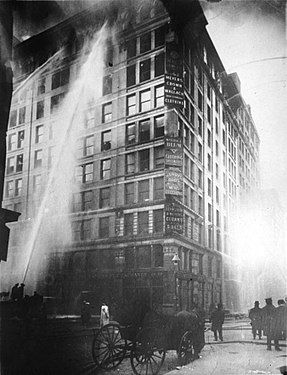
With the arrival of these fashionable separate skirts and blouses (then known as shirtwaists), standardized measurements and mass production became not only a possibility but a reality. Manufacturers began popping up all over major cities - you may have heard of the Triangle Shirtwaist Factory Fire.


Ready-to-wear slowly pushed it's way to the forefront of culture and society, and got special boosts with each of the world wars. However, couture was still king in the fashionable circles. Wealthy women still traveled to Paris each season to purchase new gowns, dresses, suits, etc.
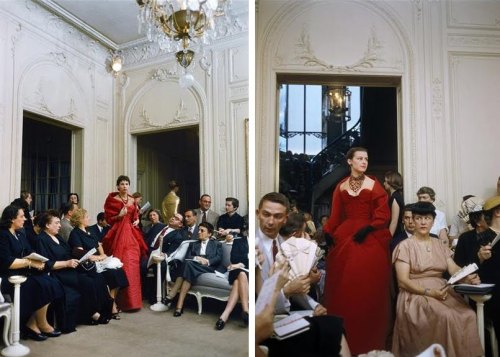
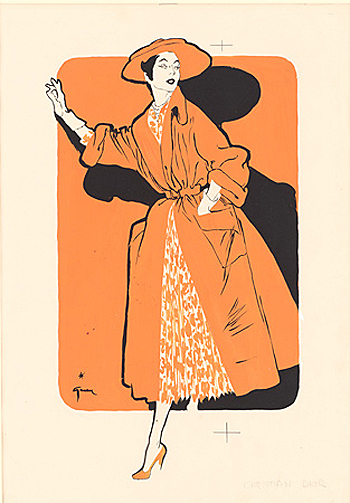
A Dior Haute Couture Show, 1950s
The next part of the story begins on October 23rd, 1957. Christian Dior, the toast of Paris, dies of a heart attack while on vacation in Montecatini, Italy. In his wake, Yves Saint-Laurent is tapped to take over the fashion juggernaut that is Dior. However, after only a few years, the investors butt heads with the young designer purposefully fail to have him excused from his military conscription. After several years of struggles with military service, doctors, and drugs, Saint-Laurent pulled himself together and in 1966 announced a ready-to-wear line. While other designers also had prêt-à-porter lines in the works, YSL is greatly credited with being the first due to his strong ideas on the subject of democratizing fashion. Saint-Laurent's Rive Gauche stores were a huge success, and this spelled the beginning of the end for couture.
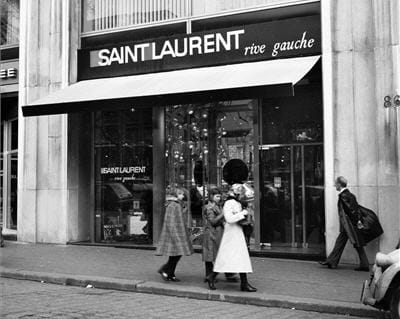

It's interesting to note that it was around this time that the miniskirt came into fashion. This is widely considered to have been the last major fashion trend. Nothing since has been so widely pervasive as the miniskirt, and it heralded the end of institutionalized fashion, where Parisian couturiers dictated the styles to the masses.


Nowadays, design companies lose money on their couture lines, and they are becoming less and less prevalent as the shows become too expensive to produce and as more and more of the artisans and craftspeople who provided lace, feathers, beading, and all of that to the design houses fold due to economic hardship. In spite of this, Saville Row has remained a bastion of bespoke against the rising tide of ready-to-wear. The tailors and seamstresses of Saville Row resent that a fast fashion company such as Abercrombie & Fitch would trespass onto what is effectively the Vatican of tailoring, and consider it both disrespectful and an economic threat.


However, will their cries be ignored? Will the suit-makers of Saville Row be swallowed up by fast fashion the way Barnes & Noble or Starbucks swallowed up so many businesses before them? Will centuries of experience and incomparable quality be replaced by lower prices and quick turn-around times? I believe they will, sadly. They simply cannot compete in a society that holds price above all other aspects of a product. I hope they'll stick around for a while yet, and at the very least live to preserve their wisdom for posterity.

Friday, May 18, 2012

Fashion Friday - Cannes of the Century

Now, I wasn't sure whether or not to wait to do this post, seeing as the Cannes Film Festival is still in full swing, and there are still several red carpets to, so maybe I'll end up doing some special weekend posts about the rest... or maybe not. Anyway, I realized a fun way for me to cover red carpet events without it just being another runway fashion review - I'll sort the gowns I like or don't like by time period! Here we go:


1900s

Romantic lace, a soft decolletage, and the diamond collar necklace all make for a beautiful Gibson Girl silhouette on the lovely Eva Herzigova. The a-la-Draper hair is simple and elegant.

1910s


Grecian detail, a wide belt, and chiffon shoulder panel all give a dash of Lucille to Eva Longoria's gown.

1920s


The simple design, drop waist and tiered ruffle skirt all give Ms. Rossy de Palma a Flapperish Flair. This gown is also reminiscent of the Sevillanas.

Honorable Mention


1930s


A Clingy silhouette, halter top, and bangles bring back memories of Nancy Cunard.

Honorable Mentions


1940s


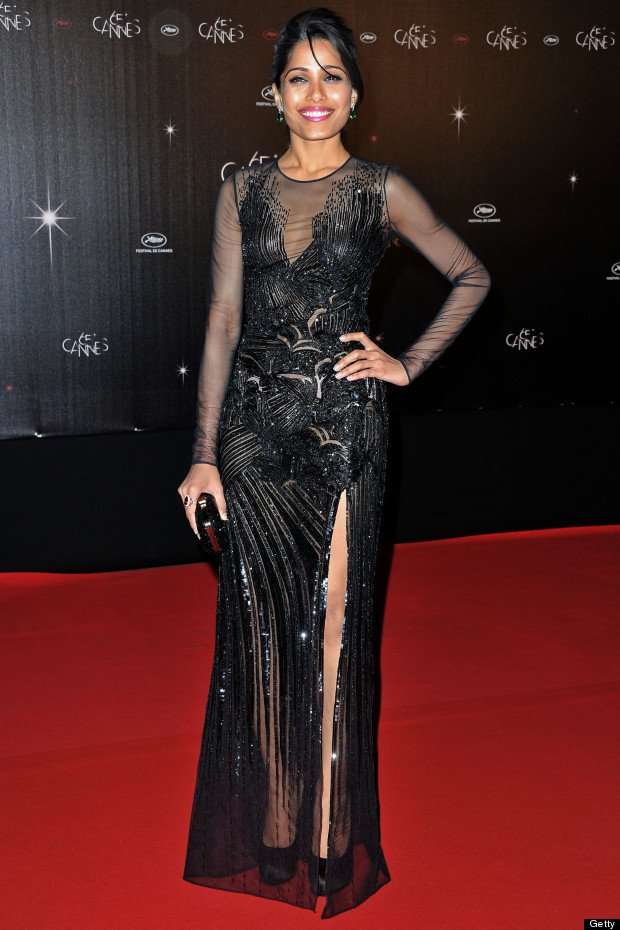
Woah. Who brought Gilda to life? This is 100% Rita Hayworth. Lovely!

Honorable Mentions


1950s


It's no surprise that Marion Cotillard should be chosen for the 50s when she's decked out in Dior. Gorgeous.

1960s


I find it ironic that Ms. Fonda should have been picked for this decade, as it was the decade of her youth. Her sweetheart neckline, ratted hair, and cinched waist all bring back the stylin' sixties.

1970s


I'm torn. I really can't tell how I feel about these disco era digs. They are very seventies, and very very much the color of mustard. Either way that is Charlie Chaplin's grand-daughter.


Hope this was fun! I might go through this again next week to round up some more dresses... Or I may simply update this post. Either way you'll be updated of anything I do with this. Have a great weekend, readers!

Monday, April 30, 2012

Musical Mondays - Katharine Hepburn in "Coco"

I have always admired the work of Gabrielle "Coco" Chanel. She was the first designer to truly liberate women and single-handedly shaped the look of the 1920s. So many of the things we consider "staples" in our wardrobes came from her. She was an amazing designer and an amazing woman to boot.

If ever a woman gave fewer f@%*s, I don't know of her.
I have also always enjoyed discovering new and obscure musicals and plays.

Look up the Broadway cast on Youtube. You will love it.
What I enjoy more than both of those things is finding a way to combine two things that I enjoy. Clearly, what I'm getting at is a combination of an obscure musical and Coco Chanel, right? Right.

"What's that, you say? The person writing this article
must be some sort of huge gay nerd, you say?"
The story itself isn't phenomenal. It's a largely fictionalized take on Chanel's comeback in 1953, as Chanel gets involved in the love life of one of her young workers and inevitably flashbacks on her own love life (again, largely fictionalized)... Basically if you took the Lifetime Chanel movie and "Coco Before Chanel" and added music, you'd have this. Normally I wouldn't even be bothered to look up something with a plot that mediocre, but there was the tiny detail of Katharine Hepburn playing the title character.

*gasp*
Both Katharine and I were ambivalent about the idea. The part had originally been imagined for Rosalind Russell, who is most famously known for *ahem* squawk-blocking Ethel Merman out of a part in the movie version.

Pictured: mixed feelings.
I say "squawk" because that's about all Russell could do, especially compared to a voice such as Ethel Merman's, but a bout of arthritis made it impossible for Russell to continue, so the producers went with yet another actress who is not known for her signing, Katharine Hepburn. It was a fair choice and she does a marvelous job, but what really struck audiences was the production design: A complex reproduction of Chanel's mirrored staircase, rotating backdrops and hidden entrances. The show won the Tony for Costume Design but not much else.

Really though, if you don't at least get a nomination you'd
 have to question your abilities as a costume designer.
All of this rigmarole is really just an excuse to show you a bunch of pretty dresses. Remember that Tony I mentioned? Well, the finale of the show is a lengthy lament by the designer about forsaking love for her work (groan) but the number features a procession of Chanel repros from 1918-1959. Check it out - you can always skip to 4:20 to get right to the dresses:


Impressive, eh? What do you think of the whole thing? Should they have gone with a different actress for the lead role? Tell me in the comments below.

Thursday, April 26, 2012

Thwarted Thursdays - Lois Lane

Surprise, surprise, I've once again been beaten by one of the technologies I've come to depend on. This time, though, I admit this was mostly my fault. I decided to add color at the last minute which turned an hour-long project into an almost-all-nighter... because I'm a masochist.

Anyway, enjoy!


Wednesday, March 2, 2011

The Good Wife's Guide


The "original" - but don't read it! I have it all below.
Allegedly an excerpt from Housekeeping Monthly, this "Good Wife's Guide" has been circulating the internet since it's inception. Some say it was even sent around by fax before e-mail took off. Most experts have discredited this article as little to no proof of its original publishing exists. However, I personally believe the advice in this article to be somewhat reflective of the time period. If you want proof, just watch any episode of "I Love Lucy", or films such as "Crime of Passion" (1957) or "All that Heaven Allows" (1955). Life for the average housewife was quite depressing, and strict gender roles paired with a cash flow coming exclusively from the husband did nothing to help. Anyway, I thought I had already done a post about Anne Taintor, but apparently I was mistaken, so I'll leave the info about her for another post and simply accompany this delightful little guide with some of her artwork.


  • Have dinner ready. Plan ahead, even the night before, to have a delicious meal ready, on time for his return. This is a way of letting him know that you have been thinking about him and are concerned about his needs. Most men are hungry when they come home and the prospect of a good meal (especially his favourite dish) is part of the warm welcome needed.
  • Prepare yourself. Take 15 minutes to rest so you'll be refreshed when he arrives. Touch up your make-up, put a ribbon in your hair and fresh-looking. He has just been with a lot of work-weary people.

  • Be a little gay and a little more interesting for him. His boring day may need a lift and one of your duties is to provide it.
  • Clear away the clutter. Make one last trip through the the main part of the house just before your husband arrives.

  • Gather up schoolbooks, toys, paper etc and then run a dustcloth over the tables.
  • Over the cooler months of the year you should prepare and light a fire for him to unwind by. Your husband will feel he has reached a haven of rest and provide you with immense personal satisfaction.
  • Prepare the children. Take a few minutes to wash the children's hands and faces (if they are small), comb their hair and, if necessary, change their clothes. They are little treasures and he would like to see them playing the part. Minimise all noise. At the time of his arrival, eliminate all noise of washer, dryer or vacuum. Try to encourage the children to be quiet.
  • Be happy to see him.
  • Greet him with a warm smile and show sincerity in your desire to please him.
  • Listen to him. You may have a dozen important things to tell him, but the moment of his arrival is not the time. Let him talk first - remember, his topics of conversation are more important than yours.
  • Make the evening his. Never complain if he comes home late or goes out to dinner, or other places of entertainment without you. Instead, try to understand his world of strain and pressure and his very real need to be at home and relax.
  • Your goal: Try to make sure your home is a place of peace, order and tranquility where your husband can renew himself in body and spirit.
  • Don't greet him with complaints and problems.
  • Don't complain if he's late home for dinner or even if he stays out all night. Count this as minor compared to what he might have gone through that day.
  • Make him comfortable. Have him lean back in a comfortable chair or have him lie down in the bedroom. Have a cool or warm drink ready for him.
  • Arrange his pillow and offer to take off his shoes. Speak in a low, soothing and pleasant voice.
  • Don't ask him questions about his actions or question his judgment or integrity. Remember, he is the master of the house and as such will always exercise his will with fairness and truthfulness. You have no right to question him.
  • A good wife always knows her place.

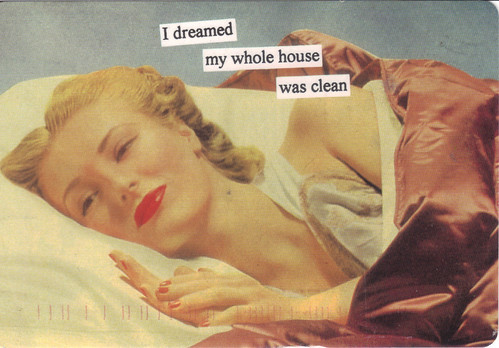
With that, I must leave you. I did have that dream last night, and it has yet to come true. Must keep the house clean for my imaginary husband's return!

Photo credits:
All images used in this article are copyright Anne Taintor, save the Good Wife's Guide which is in the Public Domain.

Enhanced by Zemanta

Thursday, December 9, 2010

A Whole New Look

I'm sure you've noticed the complete over-haul to my blog. I'm still trying to make a few tweaks, but I think I'll be able to stick to this look for quite some time. I just hate stumbling upon blogs that look exactly like mine... So, I've customized my blog even more.

I must give credit where credit is due, though - the illustration I've used as my new header is by famed Illustrator Rene Gruau. He's one of my favorite Illustrators of the 20th century, and I didn't even know it until I realized how many of the fashion drawings of the 50s and 60s I've admired for years and years. He's even influenced my own illustration work. Here is a sample of his work, followed by some of my drawings following his lead:


Probably his most famous illustration


He even dappled in menswear... sort of.

Finally, here are some of my illustrations inspired by Gruau's work:

Velvet and Sequins

Leather and Suede


Lace

Now onto a bit of administrative stuff. I'm not going to post again until next week. I have final projects due Tuesday so I'll probably prepare some stuff for Monday so I don't have to skip it again. School ends on the 18th, but the family comes in four days later for Christmas, which means my house is going to be bedlam until the 31st. I'm really going to try my hardest to post lots of interesting stuff over the holidays, but I'm not making any promises. Besides, I'm sure most of you will be too busy with your own lives to read my little 'ol blog. In any case, we shall see each other multiple times before the end of the year.

Nostalgically Yours

Enhanced by Zemanta